Abstract
AI agents consume and produce structured data under fixed token budgets. The dominant encoding is JSON, which fails at scale for two compounding reasons: 81% of its tokens are structural overhead (repeated field names, delimiters, quoting), and its grammar characters merge with adjacent content in BPE tokenizer vocabularies, hiding structural boundaries inside single tokens. A cross-tokenizer analysis of 43 tokenizers from 20 providers shows this is universal: JSON's combined adversarial surface spans 1,939 mergeable words. A controlled experiment (two identical 410M-parameter models, same data, same hyperparameters, different tokenizer) proves that preventing delimiter merges produces 3x better structured data comprehension, 3-5x better code comprehension, and zero natural language cost. JSON's structural choices create both the overhead that wastes tokens and the ambiguity that wastes attention.
We present GCF, a bidirectional text-based wire format designed to eliminate both problems. GCF supports two encoding profiles: a graph profile exploiting referential identity (local IDs), topological encoding (edge arrows), and hierarchical grouping (section headers); and a generic profile encoding arbitrary structured data with positional rows, pipe separators, and inline primitive arrays. GCF's grammar characters were selected from the set empirically verified to have near-zero merge rates across all 43 tested tokenizers: pipe (0.47% merge rate, 24 mergeable words) vs JSON's quote (8.17%, 193 words) vs TOON's tab (32.91%, 1,238 words).
We evaluated GCF across 2,500+ LLM evaluations spanning 11 models and 4 providers (Anthropic, OpenAI, Google, Mistral). No model has been trained on GCF.
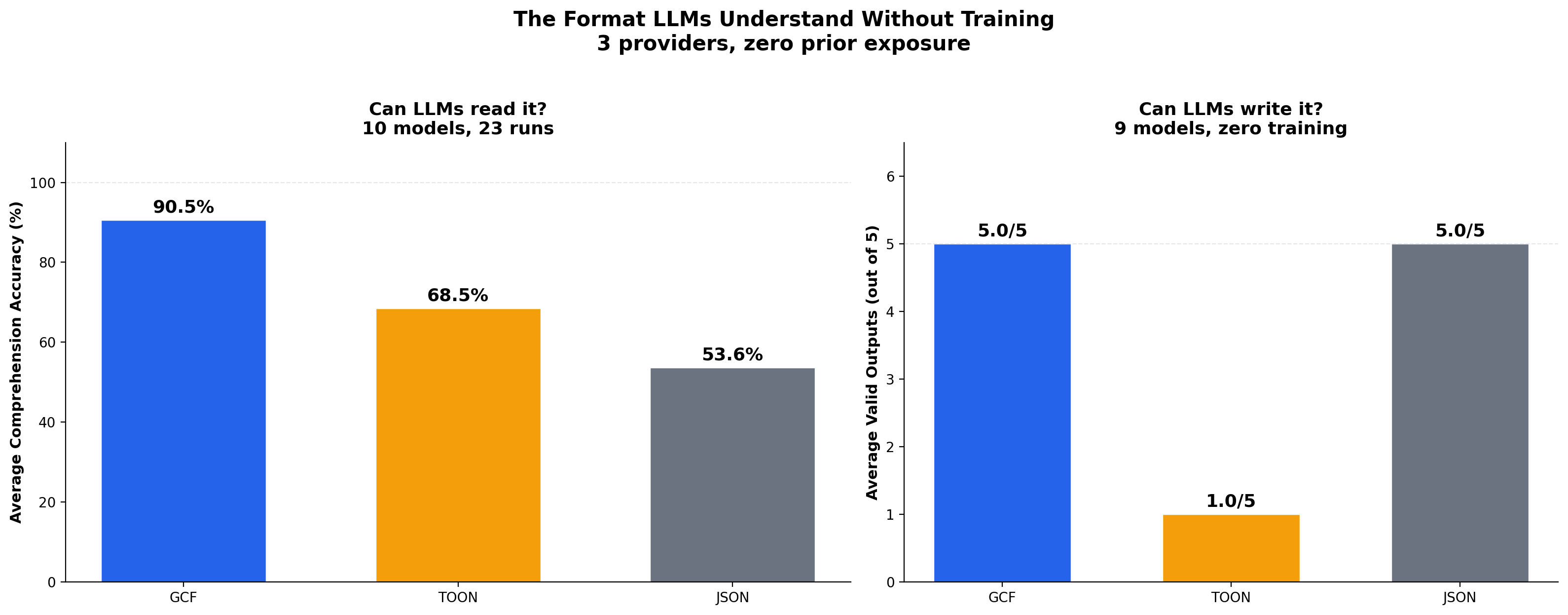
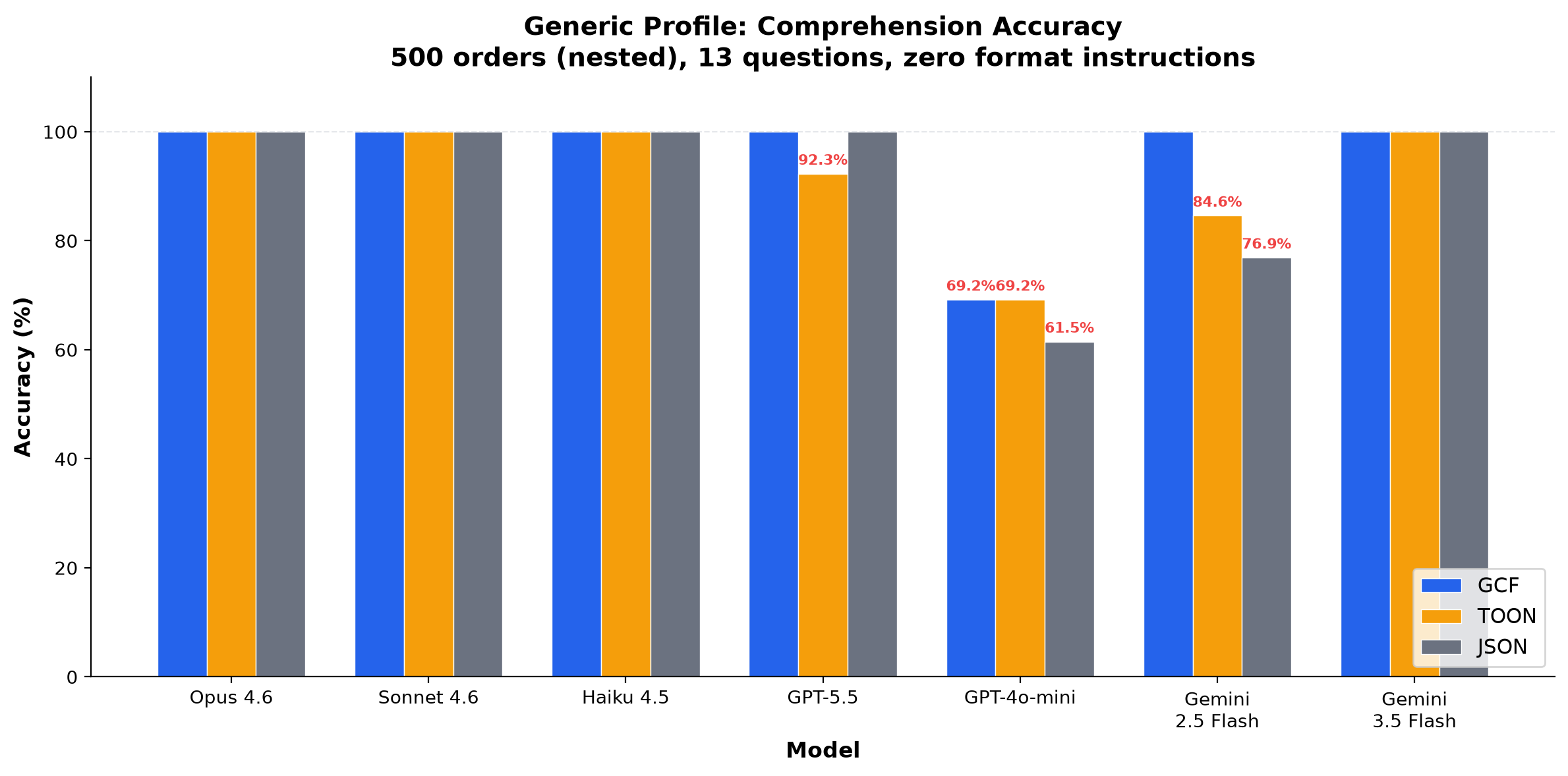
Comprehension (generic profile): 27 runs across 11 models, 500-order nested data. GCF achieves 100% on every frontier model (Opus, Sonnet, Haiku, GPT-5.5, Gemini 2.5 Pro, Gemini 3.1 Pro, Gemini 3.5 Flash). TOON is the weakest format.
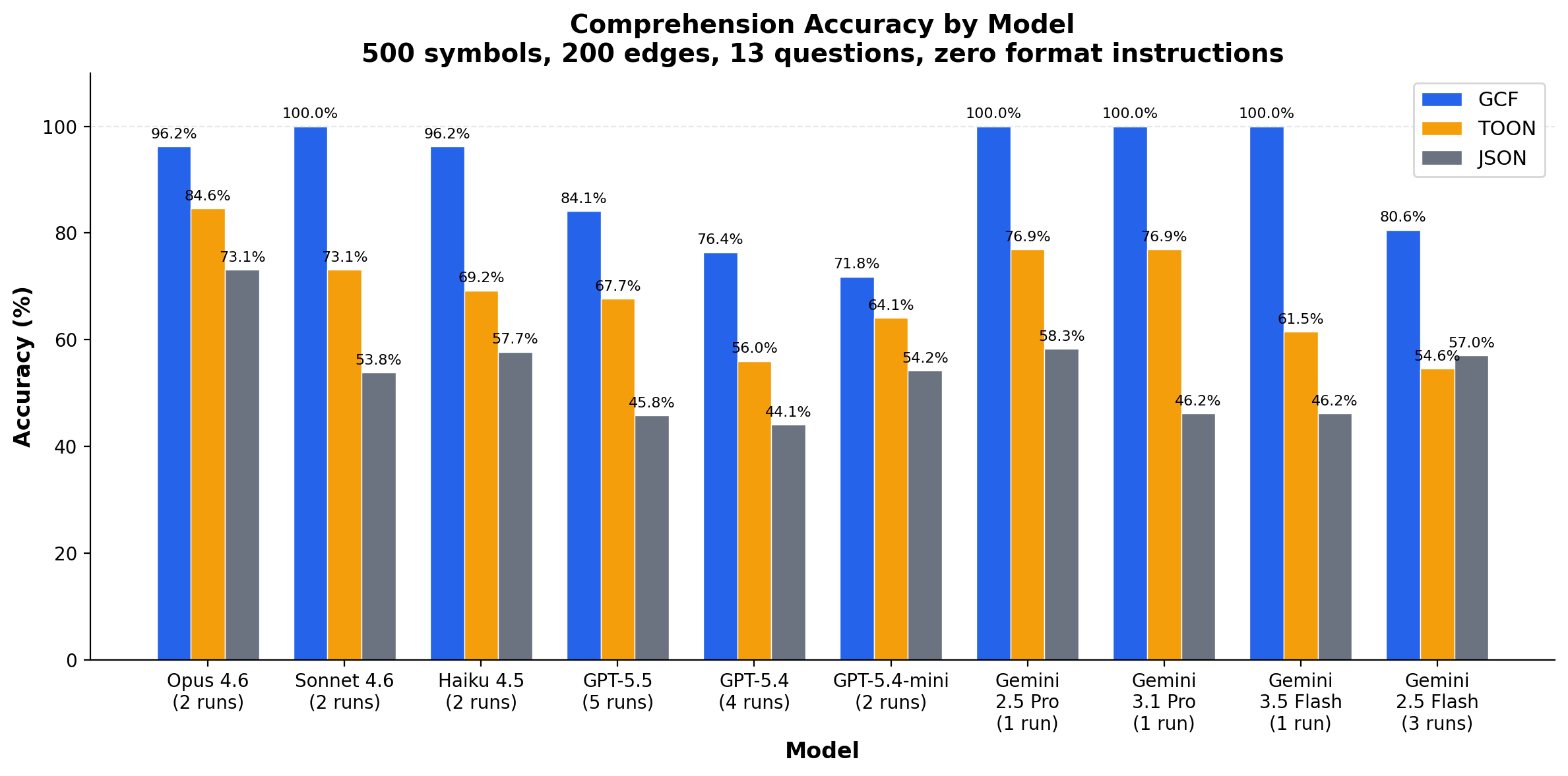
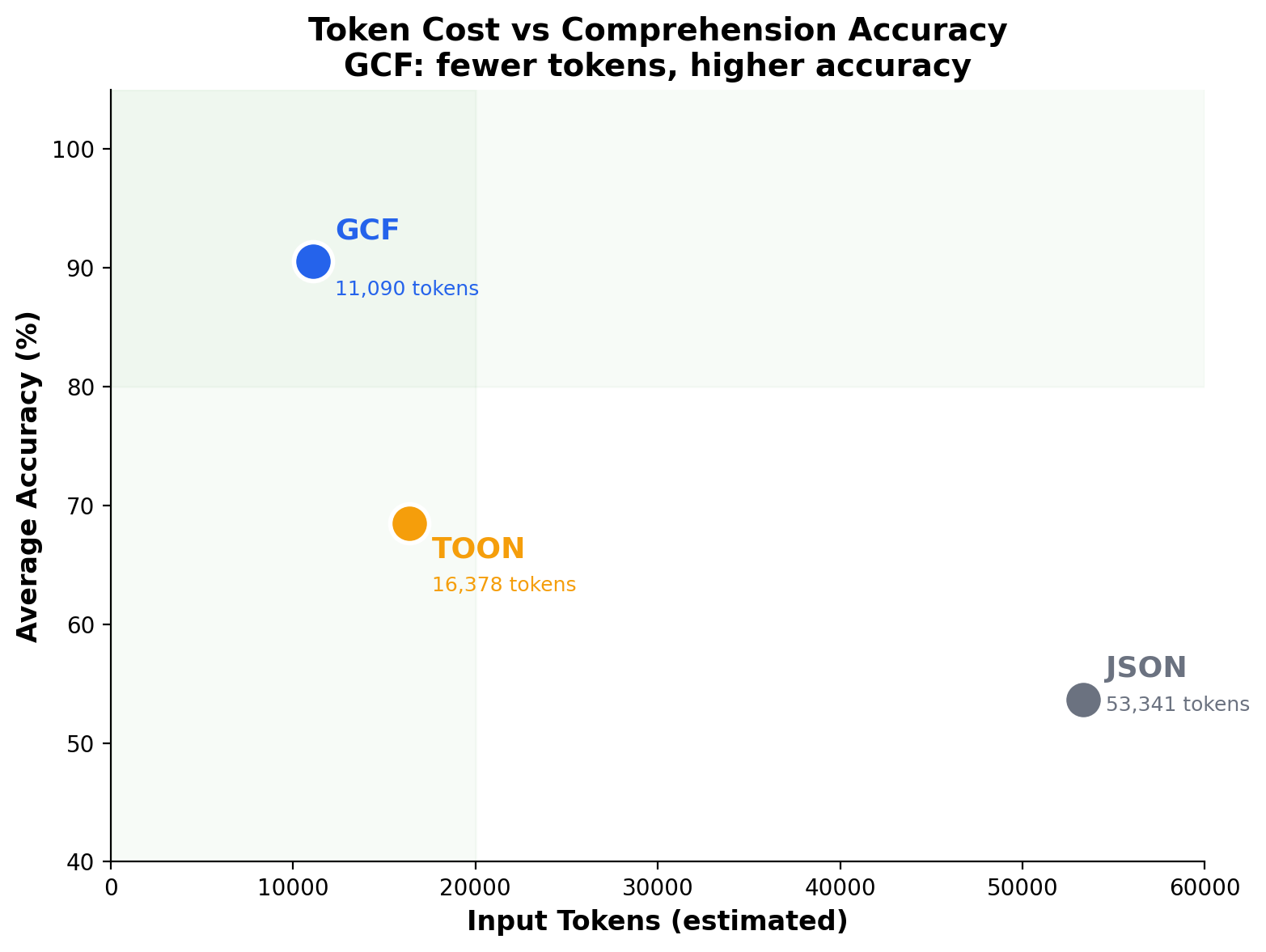
Comprehension (graph profile): 24 runs across 10 models, 500 symbols with 200 edges. GCF averages 91.2% accuracy where TOON averages 68.2% and JSON averages 53.4%. GCF wins 23 of 24 runs (1 tie, 0 losses).
Generation: 28 runs across 9 models. GCF achieves 5/5 validity on every frontier model. TOON's official decoder rejects LLM-generated output on 7 of 9 models due to a structural design flaw in flat tabular encoding. GCF output is 63% smaller than JSON and 33% smaller than TOON.
Token efficiency: GCF achieves 50-92% fewer tokens than JSON depending on data complexity and session reuse. 50-69% on a single call (generic through graph profile). Up to 92% with session deduplication across repeated tool calls. On TOON's own benchmark (their datasets, their tokenizer, their methodology), expanded from 6 to 16 datasets, GCF wins 15 of 16 (29% fewer tokens overall).
Lossless verification: 43 billion+ round-trips across 5 formats (JSON, YAML, MessagePack, CSV, TOML) with zero failures. Validated across 17 serialization formats in the Format Mega-Gauntlet.
Session deduplication (84.3% cumulative savings over a 5-call session) and delta encoding (81.2% on re-queries) compound savings across multi-turn interactions. A streaming encoding extension enables zero-buffering encode with O(1) memory per row. The format is implemented in six languages (Go, TypeScript, Python, Rust, Swift, Kotlin), 157 conformance fixtures, and deployed in production MCP servers. Specification v3.1 Stable: gcformat.com.
A companion paper, "Merge Barriers in BPE Tokenization: From Vocabulary Merges to Attention Collapse" DOI: 10.5281/zenodo.20925910, presents the full 43-tokenizer vocabulary analysis and the controlled experiment proving that delimiter choice produces measurable architectural changes in the trained transformer (4.6x more delimiter-specialized attention heads, 2.4x easier delimiter prediction, 50% more cohesive delimiter embeddings).
1. Why JSON Fails at Scale
The Model Context Protocol (MCP) defines how AI agents interact with external tools. Tool responses are overwhelmingly encoded as JSON. This is convenient for developers but expensive for the consumer that matters most: the language model itself.
JSON fails at scale for two compounding reasons, not one.
1.1 The Overhead Problem
Consider a typical MCP tool response returning 10 graph nodes and 8 edges (a blast radius query, a dependency subgraph, or a context retrieval result). In JSON, this payload consumes ~965 tokens. The same semantic content in GCF consumes ~233 tokens. The difference, 732 tokens, is pure waste: field name repetition, structural delimiters ({, }, [, ], :, ","), and full qualified names repeated in every edge reference.
At 500 rows, 81% of JSON's tokens are overhead. Only 19% carry actual data values. This waste compounds across a task. An agent making 5 tool calls during a code change task consumes ~4,825 tokens on JSON tool responses. In GCF, the same 5 calls consume ~1,165 tokens, and less with session statefulness enabled. The difference, ~3,660 tokens, is context window capacity that could hold source code, documentation, or additional tool results.
1.2 The Structural Ambiguity Problem
Token overhead is the visible problem. The deeper problem is invisible: JSON's grammar characters merge with adjacent content in BPE tokenizer vocabularies, hiding structural boundaries inside single tokens.
When GPT-4's tokenizer encounters "name":"Alice", it produces ["name][":"][Alice]["] (4 tokens). The opening quote has fused with the field name into token #32586. Claude's tokenizer produces ["][name][":"][Alice]["] (5 tokens). The structural boundary (where the field name starts) is at a different token position depending on which model processes the data.
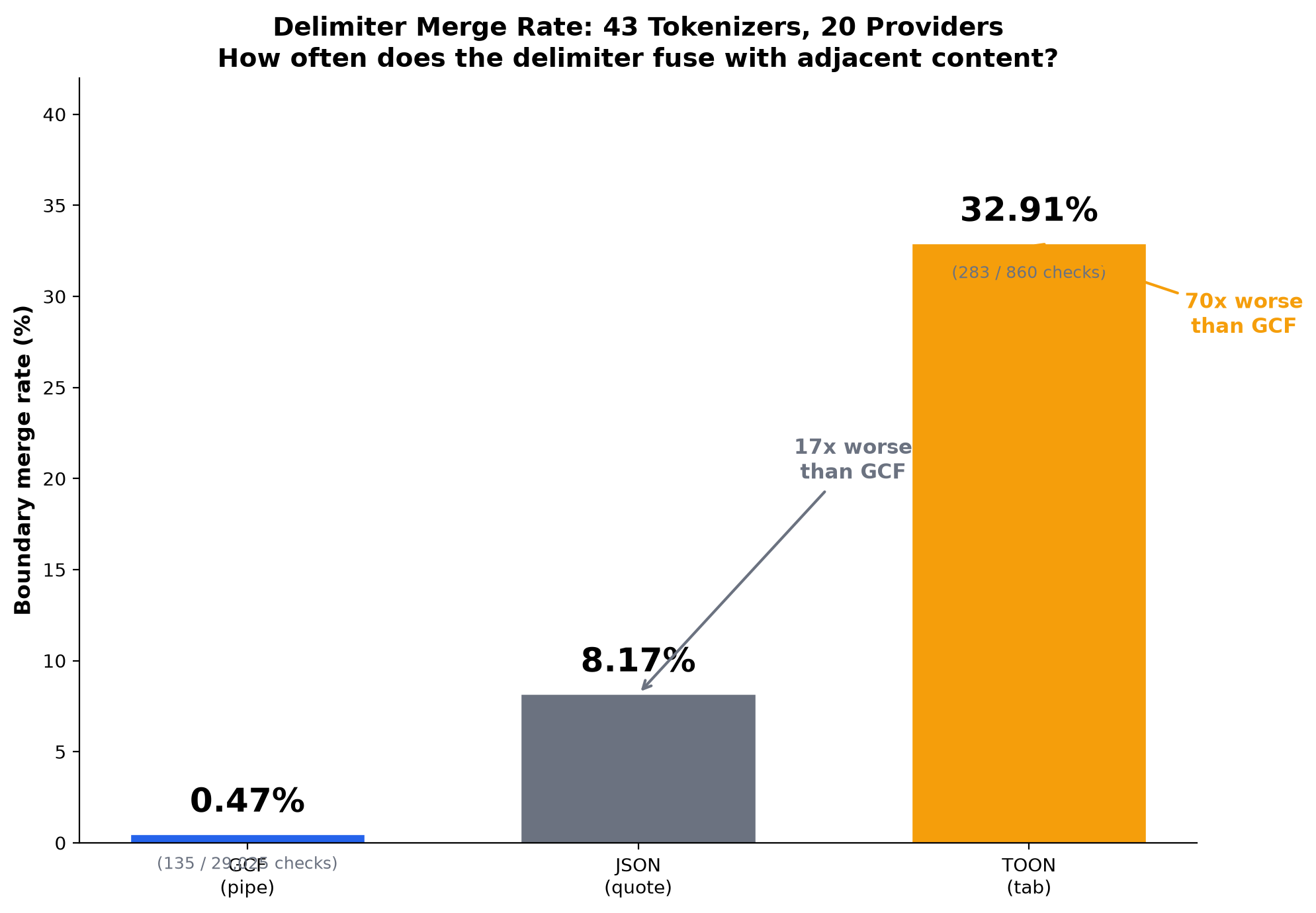
An exhaustive vocabulary scan across 43 tokenizers from 20 providers reveals that this is universal:
- JSON's opening quote merges with common field names (
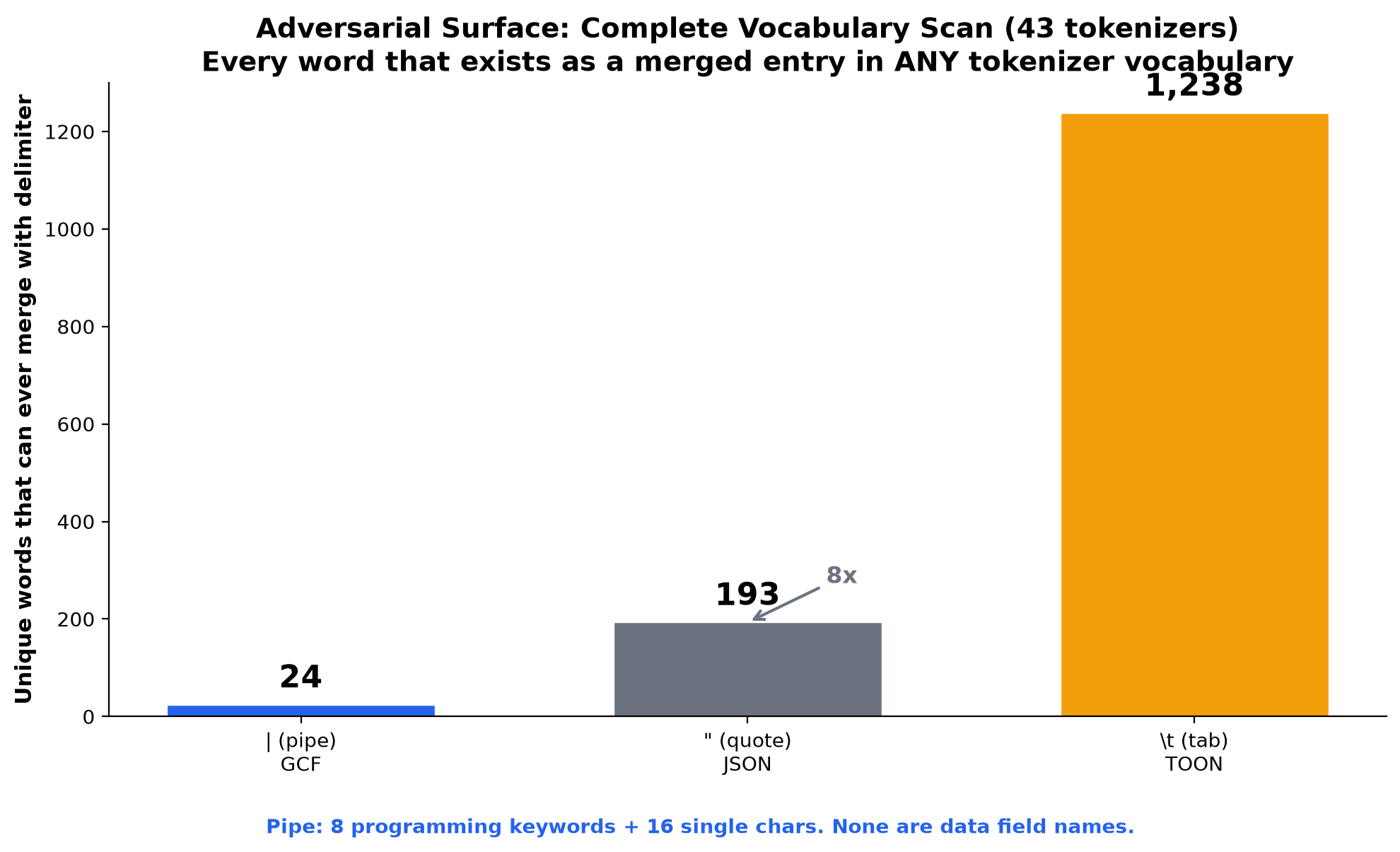
id,name,type,value,url) on 30% of tokenizers - JSON's combined adversarial surface across all 7 grammar characters: 1,939 mergeable words
- TOON's tab delimiter: 1,238 mergeable words (GPT-4o has a 100% tab merge rate)
- GCF's pipe delimiter: 24 mergeable words (all TypeScript union keywords, none are field names)
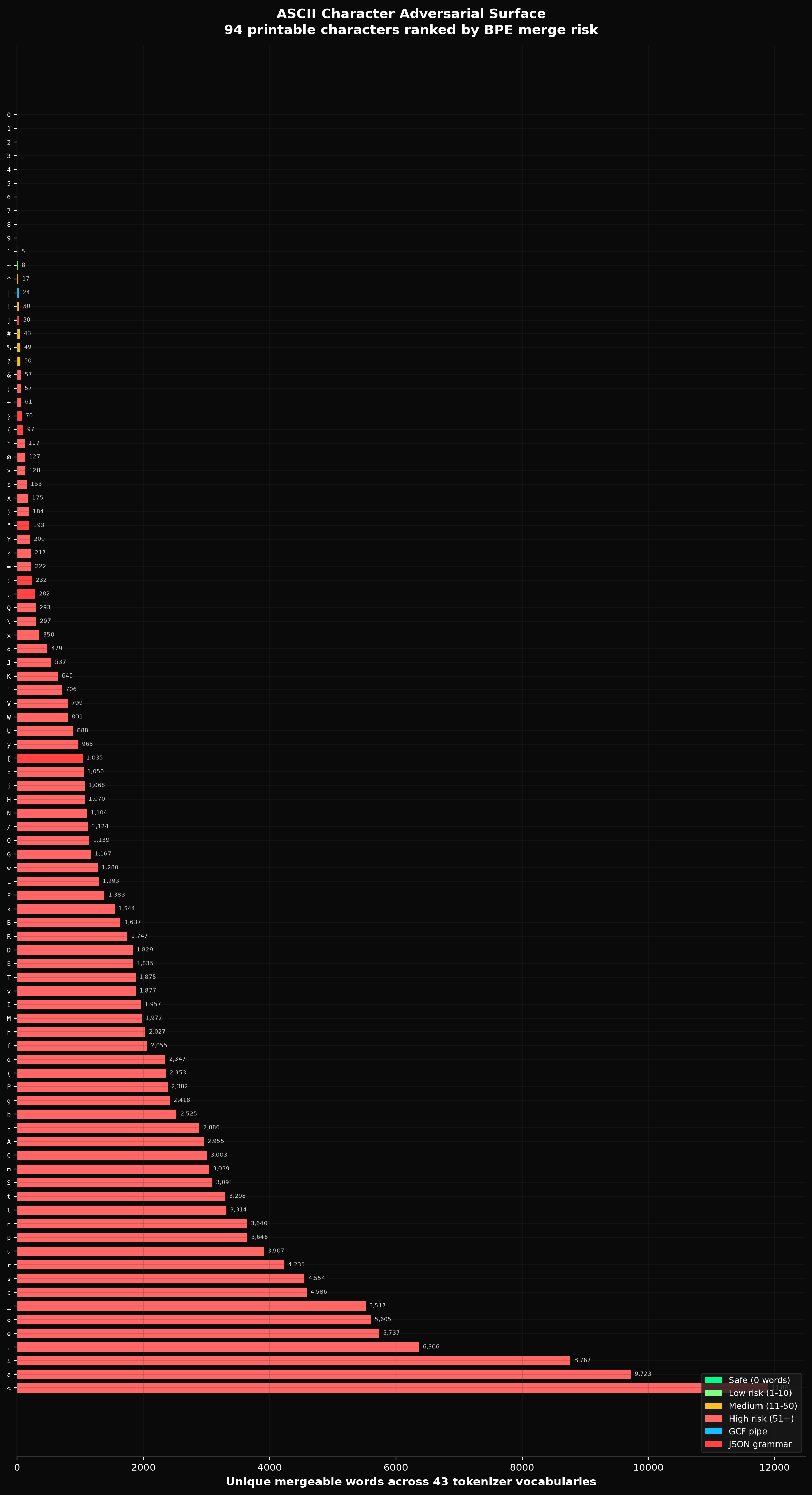
At 500 rows, the overhead problem and the ambiguity problem compound. The model must process approximately 8,500 overhead tokens (81% of the sequence) that are also structurally ambiguous (field boundaries hidden inside merged tokens). Attention entropy crosses the comparison format at 50 rows. Grammar attention collapses from 30% to 8.6%. The model stops parsing structure entirely.
A controlled experiment proves this is causal. Two identical 410M-parameter models trained on the same corpus with the same hyperparameters, differing only in whether 16 delimiter characters can participate in BPE merges, converge to identical natural language perplexity (19.4 vs 19.5) but the merge-barrier model achieves 3x lower structured data perplexity, 3-5x lower code perplexity, and develops 4.6x more delimiter-specialized attention heads. The full analysis is in the companion paper, "Merge Barriers in BPE Tokenization" DOI: 10.5281/zenodo.20925910.
GCF was designed to eliminate both problems: header factoring eliminates the overhead, and delimiter selection from the empirically verified low-merge character set eliminates the ambiguity.
1.3 Why This Matters Now
Three trends make this problem urgent:
Tool-heavy agent workflows. Modern AI agents make 10-50 tool calls per task. Each call returns JSON. Token budgets are consumed by tool overhead before the agent finishes its work.
Graph-structured responses are growing. Code intelligence, dependency analysis, knowledge graphs, and system topology queries all return graph data. Graph payloads are JSON's worst case because they contain repeated node references across edges.
Context window costs are real. Whether measured in dollars (API billing), latency (time-to-first-token), or capability (what fits in the window), every wasted token reduces the agent's effectiveness.
1.4 Why Not Just Use Binary?
Binary formats (Protocol Buffers, MessagePack, FlatBuffers) optimize for byte size and decode speed. But LLMs consume text, not bytes. A protobuf-encoded tool response must be decoded to text before the LLM can process it, and the decoded text is typically JSON, eliminating the savings at the point of consumption.
The optimization target is not bytes on wire. It is tokens in the context window. These are different quantities with different solutions.
2. Design Principles
GCF's graph profile is designed around three observations about graph data that JSON cannot exploit. Its generic profile (Section 3.6) generalizes these principles to arbitrary structured data.
2.1 Referential Identity
Graph nodes are referenced multiple times: once in their declaration and once per edge they participate in. In JSON, each reference repeats the full qualified name:
{
  "source": "github.com/org/repo/internal/mcp.NewServer",
  "target": "github.com/org/repo/internal/mcp.requireHash",
  "edge_type": "calls"
}
In GCF, nodes are declared once with a local ID and referenced by that ID thereafter:
@0 fn github.com/org/repo/internal/mcp.requireHash 0.78 lsp_resolved
@4 fn github.com/org/repo/internal/mcp.NewServer 0.54 lsp_resolved
@0<@4 calls
The full qualified name appears once per node. Every subsequent reference is 2-3 tokens (@0, @4) instead of 15-20 tokens.
2.2 Topological Encoding
JSON encodes edges as objects with named fields. GCF encodes edges as directed connections:
JSON (1 edge, ~12 tokens):
{"source": "...", "target": "...", "edge_type": "calls"}GCF (1 edge, ~5 tokens):
@0<@4 callsThe < arrow encodes direction. The source and target are local IDs. The edge type is a bare token. No field names, no delimiters, no quoting.
2.3 Hierarchical Grouping
Graph query results often partition nodes by distance from a query center: direct targets (distance 0), related symbols (distance 1), extended context (distance 2+). In JSON, each node carries a "distance": N field. In GCF, a section header replaces all per-node distance fields:
## targets
@0 fn ... 0.78 lsp_resolved
@1 method ... 0.74 lsp_resolved
## related
@4 fn ... 0.54 lsp_resolved
One header replaces N repeated fields.
3. Specification
3.1 Grammar
payload       = header LF { section } [ summary ] ;
section       = group-header LF { line LF } ;
line          = node-line | edge-line | ref-line | tabular-row
              | kv-line | nested-ref | inline-array | comment ;
summary       = "##! summary" SP key-value { SP key-value } LF ;

header        = "GCF" SP key-value { SP key-value } ;
group-header  = "##" SP group-name [ SP "[" count-or-deferred "]" [ field-decl ] ] ;
count-or-deferred = count | "?" ;
field-decl    = "{" field-name { "," field-name } "}" ;
node-line     = "@" id SP kind SP qname SP score SP provenance ;
edge-line     = "@" target "<" "@" source SP edge-type [ SP status ] ;
ref-line      = "@" id SP SP "# previously transmitted" ;
tabular-row   = [ "@" id SP ] value { "|" value } ;
kv-line       = key "=" value ;
inline-array  = key "[" count-or-deferred "]" ":" SP value { "," value } ;
nested-ref    = "." field-name ;
comment       = "#" SP text ;

id            = DIGIT { DIGIT } ;
count         = DIGIT { DIGIT } ;
kind          = "fn" | "type" | "method" | "iface" | "var" | "const"
              | "resource" | "table" | "class" | "selector" | "field"
              | "route" | "ext" | "file" | "pkg" | "svc" ;
status        = "added" | "removed" ;
3.2 Header
The header line identifies the format and carries payload metadata:
GCF profile=graph tool=context_for_task budget=5000 tokens=1847 symbols=10 edges=8tool identifies the MCP tool that produced this response. It is optional: recommended for MCP workloads, omitted for non-MCP applications. Making tool optional decouples the graph profile from MCP-specific usage, so the same encoding works in standalone code intelligence tools, data pipelines, or any context where graph-structured data enters an LLM without an MCP server in the loop. budget and tokens enable the consumer to assess utilization. symbols and edges give counts without scanning.
3.3 Node Lines
@{id} {kind} {qualified_name} {score} {provenance}Fields are positional. No field names, no delimiters beyond whitespace. Kind abbreviations reduce token count (fn vs "function", iface vs "interface").
| Abbreviation | Full form |
|---|---|
fn | function |
type | type |
method | method |
iface | interface |
var | var |
const | const |
resource | resource |
table | table |
class | class |
selector | selector |
field | field |
route | route_handler |
ext | external |
file | file |
pkg | package |
svc | service |
3.4 Edge Lines
@{target}<@{source} {edge_type} [{status}]The < arrow points toward the target. @0<@4 calls means "@4 calls @0." Status is optional: added or removed for diff payloads.
3.5 Group Headers
## targets
## related
## extended
## edges [N]
Group headers partition the payload into semantic sections. The group a node appears in encodes its distance from the query center, eliminating per-node distance fields. The edges section header includes [N] (the edge count) to enable direct count verification by the LLM without scanning.
3.6 Generic Profile (Generic Encoding)
The graph profile (Sections 3.1-3.5) encodes typed nodes and edges. The generic profile encodes arbitrary structured data using the same grammar primitives.
Tabular arrays:
## {name} [{count}]{{field1},{field2},{field3}}
value1|value2|value3
The header declares field names once. Rows are pipe-separated positional values. No field names repeated per record.
## employees [3]{id,name,department,salary}
1|Alice Smith|Engineering|95000
2|Bob Jones|Sales|72000
3|Carol Wu|Marketing|85000
Primitive arrays (all elements are scalars) are inlined on a single line:
tags[3]: production,us-east-1,critical
ports[3]: 8080,8443,9090
Key-value pairs for primitive object fields:
config=production
port=5432
active=true
Section headers for nested objects:
## database
  host=db.example.com
  port=5432
Nested fields in tabular rows use @{id} prefixes and .field {}:
## orders [2]{id,total,status,customer}
@0 1001|249.99|shipped|^
  .customer {}
    name=Alice Smith
    tier=premium
Value encoding rules:
| Type | Encoding |
|---|---|
| String | bare text |
| Number | unquoted decimal |
| Boolean | lowercase true/false |
| Null | - |
| Empty string | "" |
| String containing ` | or\n` |
Uniformity detection: An array is tabular-eligible if the first 5 elements are objects with at least 70% key overlap with the first element, accommodating semi-uniform data.
3.7 Session Statefulness
Across multiple tool calls in a session, previously-transmitted nodes can be referenced without retransmission:
GCF profile=graph tool=context_for_files tokens=800 symbols=5 edges=1 session=true
## targets
@0  # previously transmitted
@7 fn github.com/org/repo/internal/mcp.handleBlastRadius 0.62 lsp_resolved
## edges [1]
@0<@7 calls
The session=true header flag enables ID persistence. A bare @0 (no kind, name, or score) references a node transmitted in a previous response. Multi-call workflows get progressively cheaper as the session builds a shared vocabulary.
This exploits a property unique to agent tool interactions: the consumer (the LLM) maintains conversational state across calls. A traditional wire format cannot assume its consumer remembers previous messages. GCF can because LLM context windows are, by definition, stateful.
3.8 Streaming Encoding Extension
When the encoder does not know payload size upfront (data arriving incrementally from a database cursor, API pagination, or graph traversal), it uses streaming mode:
GCF profile=graph tool=context_for_task budget=5000
## targets
@0 fn pkg.Auth 0.95 lsp_resolved
@1 fn pkg.Handler 0.88 lsp_resolved
## related
@2 type pkg.Config 0.72 ast_inferred
## edges [?]
@0<@1 calls
@2<@0 references
##! summary symbols=3 edges=2 sections=targets:2,related:1,edges:2
The [?] deferred count marker signals that the count will be provided in the trailer. The ##! summary line provides all counts after the data is complete. The LLM has both the data and the counts in its context window (recency bias in transformer attention means the trailer is at least as strong a signal as header counts).
Streaming mode enables zero-buffering encode: rows emit the instant they are produced, with O(1) memory per row. This is critical for MCP servers that walk large graphs or paginate results; the LLM starts receiving context immediately instead of waiting for the full traversal.
TOON cannot add streaming without a breaking spec change (their grammar mandates upfront [N] with no deferred count or trailer mechanism).
4. Implementation Status
GCF is not a speculative format proposal. It is implemented in six languages, published to seven package registries, covered by 157 conformance fixtures, verified across 43 billion+ lossless round-trips, and deployed in production MCP servers.
The implementation includes:
- Go library (
github.com/blackwell-systems/gcf-go, v0.6.1): Encode, Decode, EncodeGeneric, DecodeGeneric, EncodeWithSession, EncodeDelta, StreamEncoder, GenericStreamEncoder. Zero dependencies. - TypeScript library (
@blackwell-systems/gcfon npm, v0.6.1): encode, decode, encodeGeneric, decodeGeneric, encodeWithSession, encodeDelta, StreamEncoder, GenericStreamEncoder. Zero dependencies, ESM. - Python library (
gcf-pythonon PyPI, v0.5.1): encode, decode, encode_generic, decode_generic, encode_with_session, encode_delta, StreamEncoder, GenericStreamEncoder. Zero dependencies, Python 3.9+. - Rust library (
gcfon crates.io, v0.5.1): encode, decode, encode_generic, decode_generic, encode_with_session, encode_delta, StreamEncoder, GenericStreamEncoder. Minimal dependencies (serde_json). - Swift library (
gcf-swiftvia SPM, v0.5.1): encode, decode, encodeGeneric, decodeGeneric, encodeWithSession, encodeDelta, StreamEncoder, GenericStreamEncoder. Zero dependencies. - Kotlin library (
gcf-kotlinvia JitPack, v0.5.1): encode, decode, encodeGeneric, decodeGeneric, encodeWithSession, encodeDelta, StreamEncoder, GenericStreamEncoder. Zero dependencies. - MCP proxy (
github.com/blackwell-systems/gcf-proxy): drop-in wrapper for any MCP server, re-encodes JSON responses as GCF with streaming progress notifications. Zero code changes to upstream. - Conformance test suite (157 v3 fixtures across both profiles): language-agnostic JSON fixtures validating encode, decode, session, delta, generic, streaming, and normative error cases.
- Specification (SPEC.md, v3.1 Stable): RFC 2119 keywords, conformance checklists, decoder error taxonomy, streaming extension, security considerations. Published at gcformat.com.
Correctness Validation
All six implementations are tested against round-trip invariants and the shared conformance suite. A graph response encoded as GCF and decoded back must preserve node identity, kind, score, provenance, group membership, edge direction, edge type, and optional status metadata. The generic profile is validated against 18 additional fixtures covering flat arrays, nested objects, value formatting, primitive array inlining, and edge cases.
Production Deployment
- knowing (28 MCP tools): GCF as primary output format for code intelligence, with session deduplication and delta encoding.
- agent-lsp (66 MCP tools): GCF tabular output via EncodeGeneric for symbol lists, references, diagnostics, and call hierarchies.
5. Where Token Savings Come From
The savings decompose into five sources:
| Source | JSON cost | GCF cost | Savings per occurrence |
|---|---|---|---|
| Field names | 9 field names x ~2 tokens each = ~18 tokens/symbol | 0 (positional) | ~18 tokens/symbol |
| Edge references | 2 qualified names x ~15 tokens = ~30 tokens/edge | 2 local IDs x ~1 token = ~2 tokens/edge | ~28 tokens/edge |
| Structural delimiters | {, }, [, ], :, "," = ~6 tokens/symbol | 0 | ~6 tokens/symbol |
| Distance fields | "distance": N = ~3 tokens/symbol | 0 (implicit in group) | ~3 tokens/symbol |
| Kind strings | "function" = ~2 tokens | fn = 1 token | ~1 token/symbol |
For a 10-symbol, 8-edge payload: JSON ~965 tokens, GCF ~233 tokens. The 732-token difference breaks down roughly as: 280 from field name elimination, 224 from edge reference compression, 60 from delimiter removal, 30 from group headers, and the remainder from kind abbreviations and whitespace.
5.1 Generic Profile Savings
The generic profile achieves savings through a subset of the same mechanisms:
| Source | JSON cost | GCF cost | Savings per occurrence |
|---|---|---|---|
| Field names | repeated per record | declared once in header | ~(N-1) x fields per array |
| Structural delimiters | {, }, :, ,, " per record | ` | ` between values |
| Array framing | [, ], commas | [count] in header | fixed |
| Primitive arrays | ["a","b","c"] with brackets and quotes | name[3]: a,b,c | ~50% per array |
| Nesting | braces + field names | .field {} + key=value | ~50% per nested object |
For 2,000 employee records with 6 fields: JSON ~127,050 tokens, GCF ~49,055 tokens (61% savings). On TOON's benchmark (expanded from 6 to 16 real-world datasets), GCF wins 15 of 16 with 29% fewer tokens overall and 54.8% fewer than JSON.
6. Benchmarks
All benchmarks encode the same semantic content in JSON and GCF. Token counts in Section 6.1 use cl100k_base; the 500-symbol eval (Section 6.1b) and TOON comparison (Section 7.5) use o200k_base (matching TOON's benchmark methodology). Measurements taken on Apple M4 Pro.
6.1 Token Comparison
| Payload | Symbols | Edges | JSON tokens | GCF tokens | Savings |
|---|---|---|---|---|---|
| context_for_task | 10 | 8 | 965 | 233 | 75.9% |
| context_for_task (large) | 30 | 24 | 2,968 | 649 | 78.1% |
| context_for_files | 15 | 12 | 1,490 | 334 | 77.6% |
| blast_radius | 8 | 6 | 835 | 208 | 75.1% |
| semantic_diff | 12 | 10 | 1,206 | 295 | 75.5% |
| graph_query | 20 | 16 | 2,078 | 423 | 79.6% |
Median token savings: 76.7%
Savings increase with payload size because the ratio of edge references to node declarations grows, and edge references are where compression is strongest.
6.1a Generic Profile: Standard Workloads
27 runs across 11 models and 4 providers. 500 orders with nested customer objects and line items. 13 structured extraction questions. Zero format instructions. Deterministic answers, no LLM judge.
| Model | Provider | Runs | GCF avg | TOON avg | JSON avg |
|---|---|---|---|---|---|
| Claude Opus 4.6 | Anthropic | 2 | 100% | 100% | 100% |
| Claude Sonnet 4.6 | Anthropic | 3 | 100% | 97.4% | 100% |
| Claude Haiku 4.5 | Anthropic | 4 | 100% | 100% | 100% |
| GPT-5.5 | OpenAI | 2 | 100% | 96.2% | 100% |
| Gemini 2.5 Pro | 3 | 100% | 100% | 100% | |
| Gemini 3.1 Pro Preview | 1 | 100% | 100% | 100% | |
| Gemini 3.5 Flash | 2 | 100% | 100% | 100% | |
| Gemini 2.5 Flash | 4 | 95.0% | 85.1% | 74.0% | |
| Mistral Medium 3.5 | Mistral | 4 | 82.7% | 76.9% | 82.0% |
| Mistral Large 3 | Mistral | 1 | 69.2% | 69.2% | 69.2% |
| GPT-4o-mini | OpenAI | 1 | 69.2% | 69.2% | 61.5% |
Frontier models (Opus, Sonnet, Haiku, GPT-5.5, Gemini 2.5 Pro, Gemini 3.1 Pro, Gemini 3.5 Flash) achieve 100% GCF on every run. GCF averages equal or better than JSON on every model. TOON is consistently the weakest format.
6.1b Graph Profile: Under Structural Stress
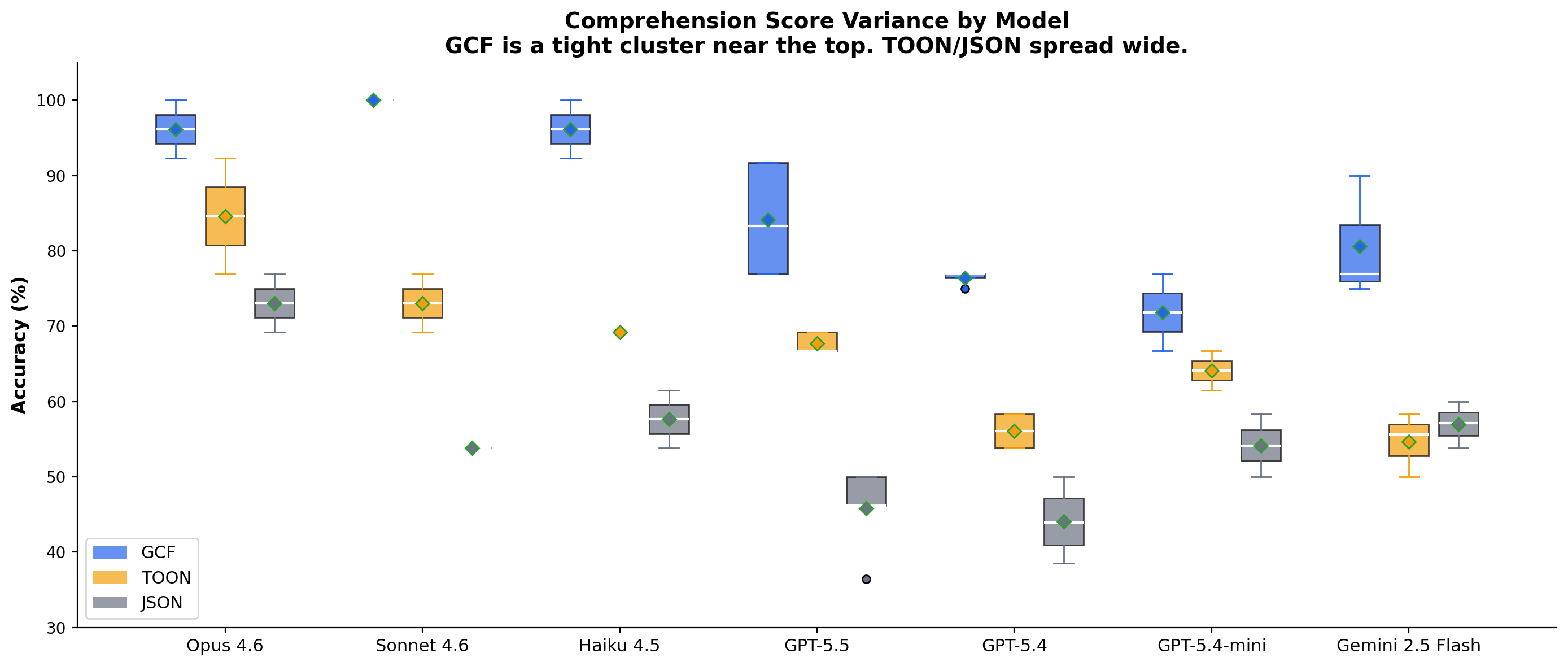
24 runs across 10 models. 500 symbols, 200 edges, 13 structured extraction questions with deterministic ground truth (no LLM judge). Each run generates a fresh random payload. Zero format instructions in the prompt.
| Model | Runs | GCF avg | TOON avg | JSON avg |
|---|---|---|---|---|
| Claude Opus 4.6 | 2 | 96.2% | 84.6% | 73.1% |
| Claude Sonnet 4.6 | 2 | 100% | 73.1% | 53.8% |
| Claude Haiku 4.5 | 2 | 96.2% | 69.2% | 57.7% |
| GPT-5.5 | 5 | 84.1% | 67.7% | 45.8% |
| GPT-5.4 | 4 | 78.0% | 56.0% | 44.1% |
| GPT-5.4-mini | 2 | 71.8% | 64.1% | 54.2% |
| Gemini 2.5 Pro | 1 | 100% | 76.9% | 58.3% |
| Gemini 3.1 Pro | 1 | 100% | 76.9% | 46.2% |
| Gemini 3.5 Flash | 2 | 100% | 53.9% | 46.2% |
| Gemini 2.5 Flash | 4 | 85.5% | 52.5% | 54.3% |
GCF wins 23 of 24 runs (1 tie, 0 losses). Four models achieve 100%.
Failure taxonomy
GCF, TOON, and JSON produce qualitatively different failure modes. The tokenizer analysis provides the mechanistic link: JSON's grammar symbols merge with field names in BPE tokenizer vocabularies, creating hidden structural boundaries that compound per row. A controlled experiment confirms this is causal: models trained with merge barriers (where delimiter characters cannot fuse with adjacent content) develop 4.6x more delimiter-specialized attention heads and achieve 3x lower structured data perplexity. See "Merge Barriers in BPE Tokenization" DOI: 10.5281/zenodo.20925910 for the full analysis.
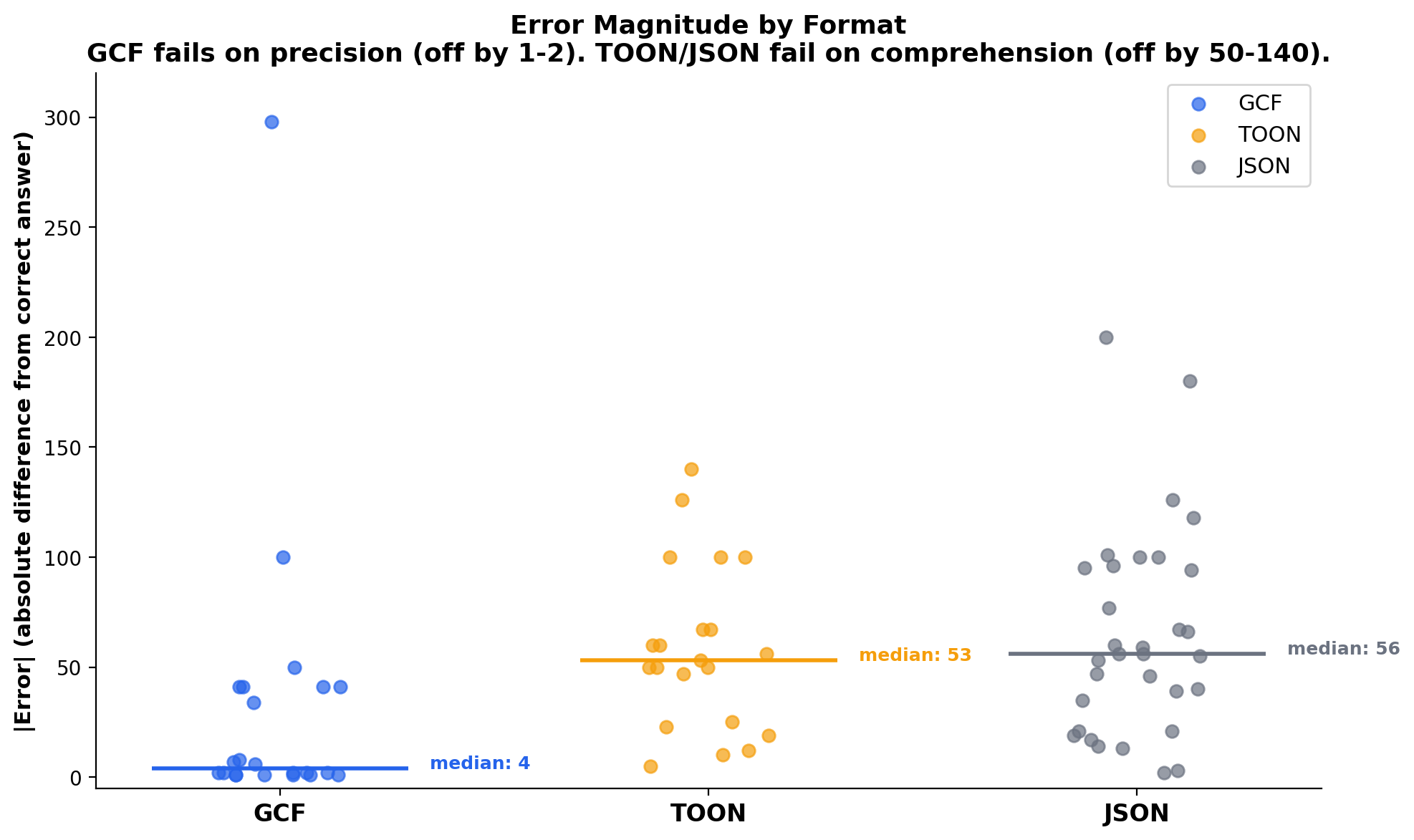
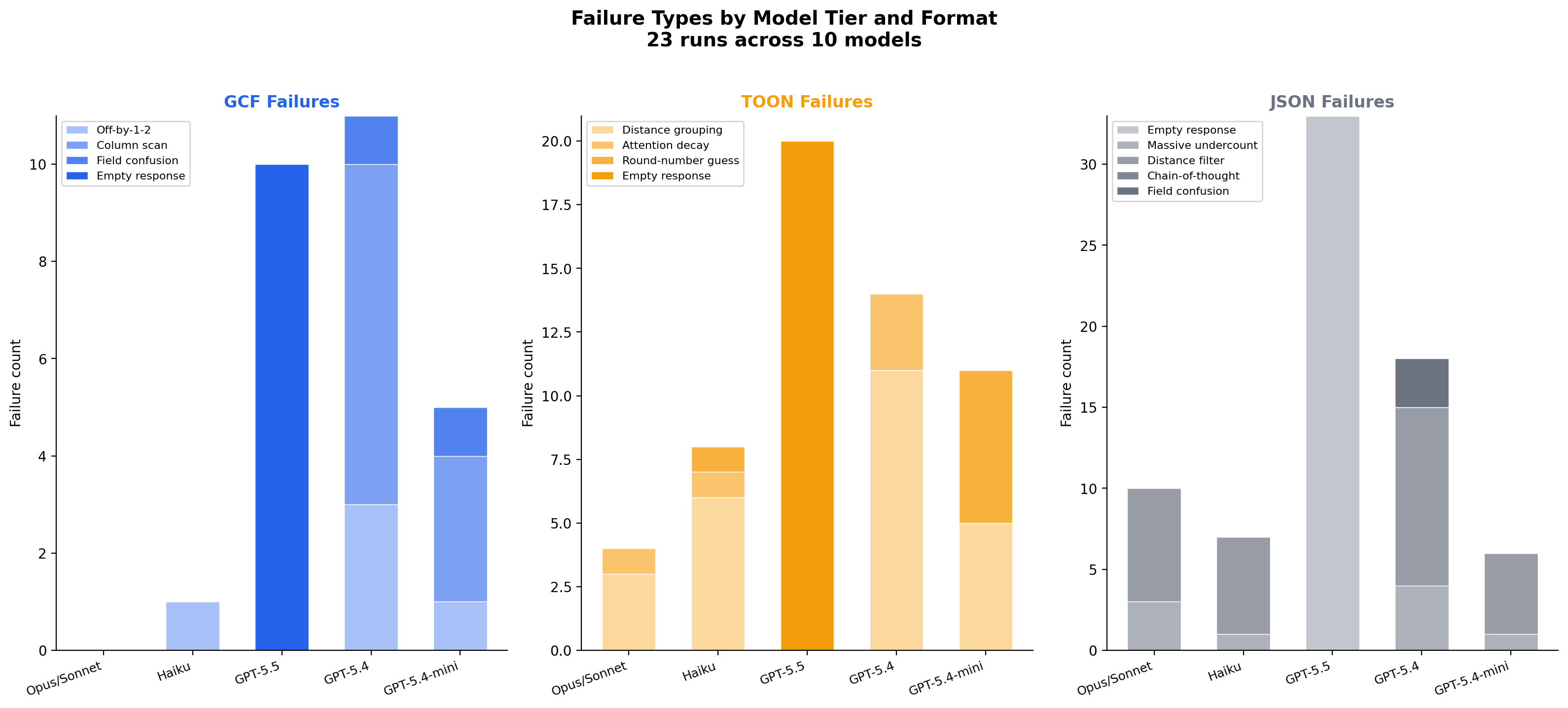
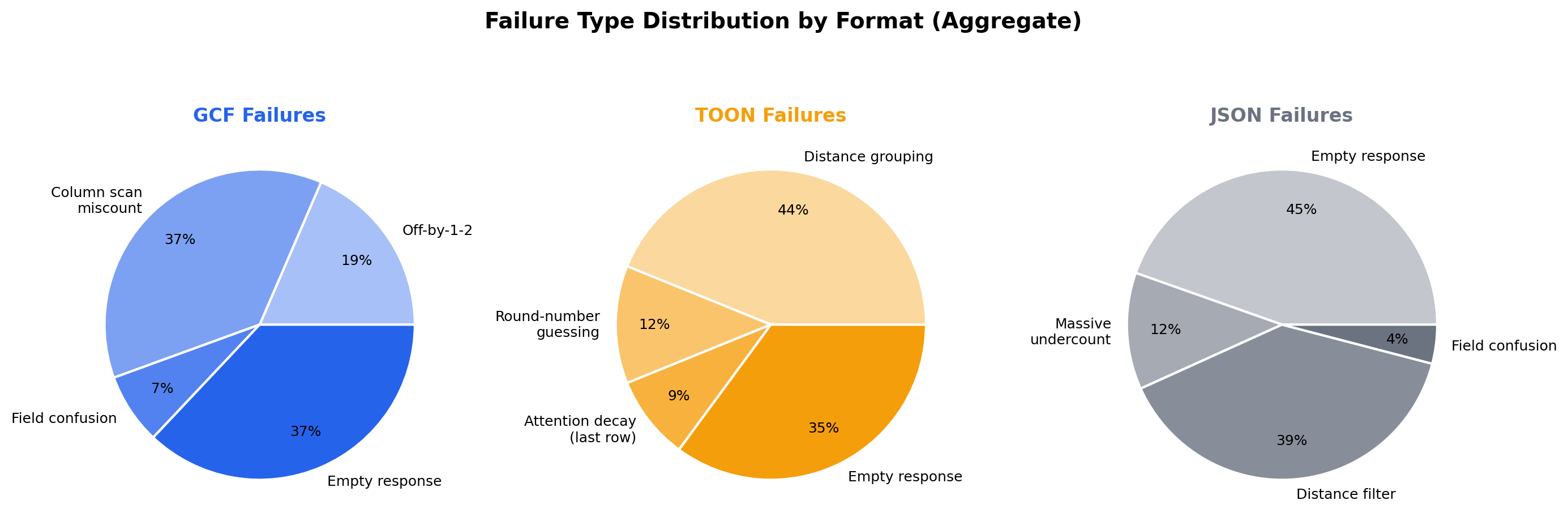
GCF fails on precision (median error: 4). Off-by-1-2 header misreads (8 occurrences), deterministic column scan miscounts on GPT-5.4 (11), field confusion (2), miscellaneous (5), and context overwhelm empty responses on GPT-5.5 (10). The format structure is understood; the count is slightly misread. 36 total failures across 24 runs. GCF's pipe delimiter has a 0.47% merge rate across 43 tokenizers, meaning the model always sees clean structural boundaries.
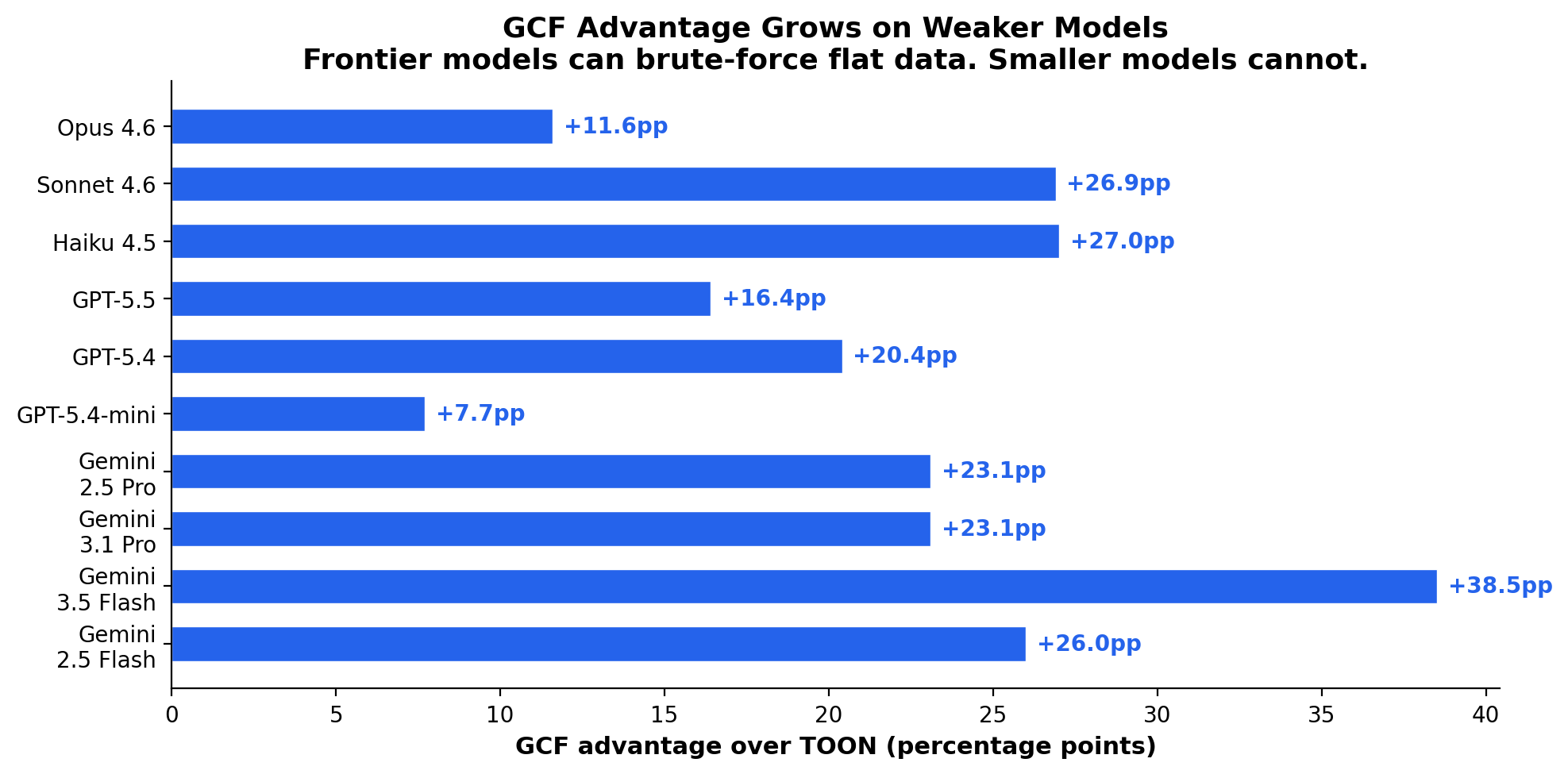
TOON fails on comprehension (median error: 53). Distance grouping failures across all models (45 occurrences), column scan miscounts (10), attention decay on the last row (7), calls edge miscounts (10), symbol count wrong (2), and context overwhelm (20). The model cannot filter a flat 500-row table by column value. 94 total failures across 24 runs. TOON's tab delimiter has a 32.91% merge rate and 1,238 mergeable words in tokenizer vocabularies, the worst of any common separator character.
JSON fails on structural overwhelm (median error: 56). Empty string responses where the model produces nothing (33), massive undercounts (14), distance filter failures (44), column scan miscounts (37), and attention decay (3). At 53,000 tokens of repeated field names, the format itself prevents comprehension. JSON's grammar attention collapses from 30% to 8.6% at scale as the model stops attending to structural tokens. 131 total failures across 24 runs.
On two separate runs, Claude Opus responded to a JSON counting question by manually enumerating symbols one by one (143 lines on run 1, 119 on run 2), burning output tokens on a chain-of-thought enumeration and still getting the wrong answer. GCF answers the same question from a 3-character header: [167].
Comprehension methodology
- OpenAI runs used default temperature (non-zero).
EVAL_TEMPERATURE=0available for deterministic runs. - Claude evals via
claude -pCLI with--modelflag. - OpenAI evals via chat completions API with exponential backoff on 429s.
- Google evals via generativelanguage API with retry logic.
- TOON encoding uses the official
toon-golibrary from thetoon-formatGitHub organization. - All raw logs in
eval/results/comprehension/.
6.2 Session Statefulness Savings
| Call | New symbols | Reused symbols | GCF tokens | Cumulative savings vs JSON |
|---|---|---|---|---|
| 1 | 10 | 0 | 233 | 75.9% |
| 2 | 5 | 4 | 128 | 82.3% |
| 3 | 3 | 6 | 87 | 86.1% |
| 4 | 2 | 7 | 62 | 89.4% |
| 5 | 1 | 8 | 41 | 92.7% |
By the fifth tool call in a session, GCF achieves 92.7% token savings versus JSON because 8 of 9 referenced symbols are bare ID references (@0, @3) consuming 1 token each instead of 15-20 tokens for the full qualified name.
At production scale (500 symbols, 200 edges per call), session deduplication achieves 84.3% cumulative savings over 5 calls (148,360 JSON tokens vs 23,270 GCF tokens). Per bare reference: 2 tokens vs 19 tokens for a full declaration (89% savings per deduplicated symbol). Cross-tokenizer validated (86-90% savings at 90% overlap). JSON has no deduplication mechanism; every call retransmits the full payload.
7. Comparison to Alternatives
7.1 Columnar/TSV
Column headers with tab-separated values eliminate field name repetition, achieving ~27% token savings. But TSV treats graph data as flat tables: edge references still require full identifier strings in each row. TSV cannot exploit referential identity (local IDs) or topological encoding (edge arrows). GCF triples the savings.
7.2 Binary Formats (Protobuf, MessagePack, FlatBuffers)
These optimize for machine parsing and byte size. An LLM cannot read a protobuf payload; it must be decoded to text first, and the decoded text is typically JSON, eliminating the savings at the point of consumption. Binary formats solve a different problem (machine efficiency) than GCF (LLM token efficiency).
7.3 JSON-LD / RDF
Verbose by design: full URIs, type annotations, @context declarations. Optimizes for semantic interoperability across systems, not token-constrained consumption. JSON-LD is worse than JSON for LLM tool responses.
7.4 Markdown / Freeform Text
Some tools return markdown-formatted text. This is human-optimized, not LLM-optimized. Markdown uses whitespace for structure (indentation, line breaks, headers) which tokenizers handle inconsistently. GCF's positional format produces consistent, predictable token counts regardless of tokenizer implementation.
7.5 TOON (Token-Oriented Object Notation)
TOON is a tabular encoding format for JSON that declares array fields once and uses comma-separated rows. It achieves 30-60% savings versus JSON on flat tabular data.
TOON:
tool: example
symbols[3]{name,kind,score,distance}:
  pkg.Auth,function,0.9,0
  pkg.Server,function,0.7,1
  pkg.Cache,type,0.4,2
edges[1]{source,target,type}:
  pkg.Server,pkg.Auth,calls
GCF (same data):
GCF profile=graph tool=example symbols=3 edges=1
## targets
@0 fn pkg.Auth 0.90 lsp
## related
@1 fn pkg.Server 0.70 lsp
## extended
@2 type pkg.Cache 0.40 structural
## edges [1]
@0<@1 calls
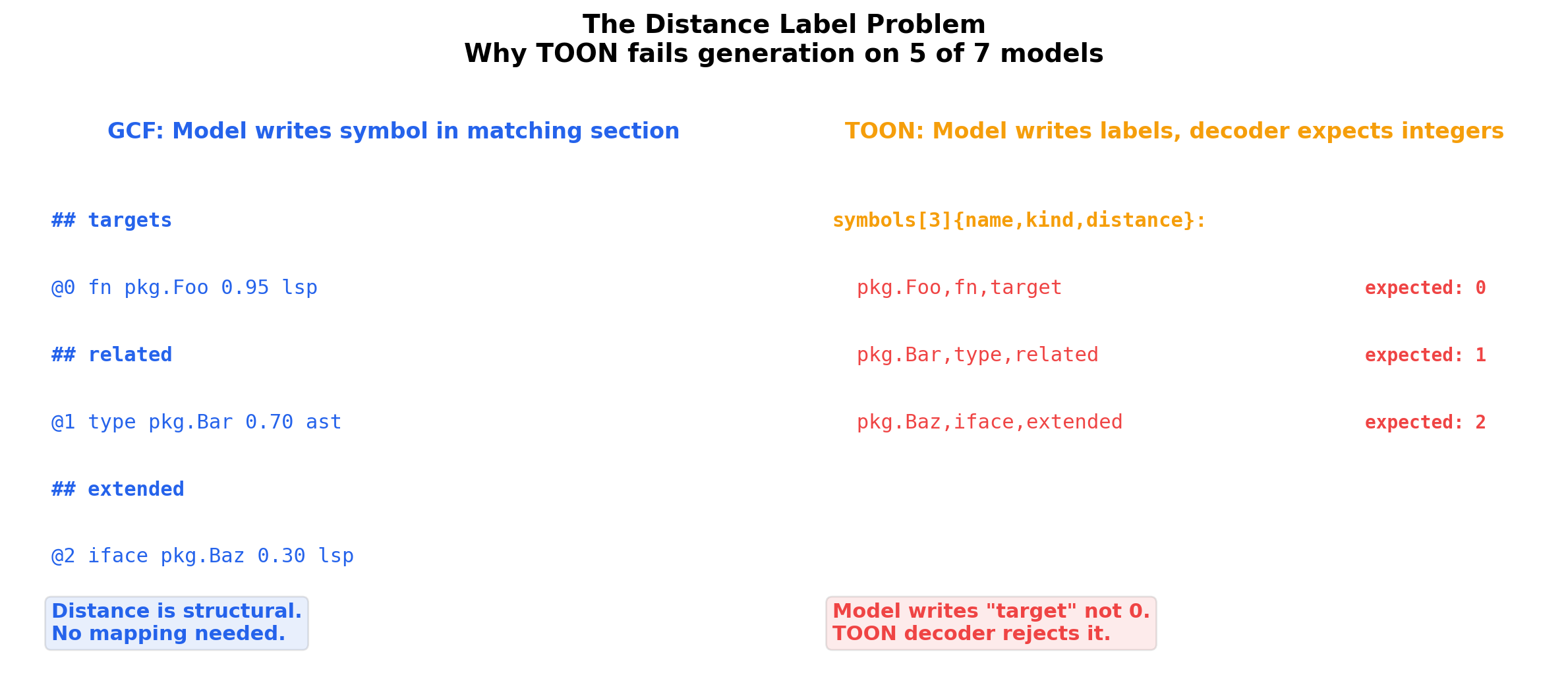
The structural difference: TOON puts all symbols in one flat table with a distance column. GCF groups them into ## targets, ## related, ## extended sections. This difference drives both the comprehension gap (models can't filter flat tables at scale) and the generation gap (models write "target" instead of 0 in TOON's distance column).
Methodology: We forked TOON's benchmark repository (github.com/blackwell-systems/toon-benchmark), added GCF as one additional formatter, and expanded from their original 6 datasets to 16 representing real-world MCP tool responses. Tokenizer (o200k_base) and methodology are upstream. GCF wins 15 of 16, 29% fewer tokens overall, 54.8% fewer than JSON. See benchmarks for the full 15-dataset table.
Tokenization analysis: TOON's tab delimiter merges with adjacent content more aggressively than JSON's quote character. Across 43 tokenizers and 29,025 checks: GCF pipe merge rate 0.47%, JSON quote merge rate 8.17%, TOON tab merge rate 32.91%. An exhaustive vocabulary scan reveals GPT-4 has 1,173 tab+letter vocabulary entries vs 22 pipe+letter entries. TOON's tab has 1,238 unique mergeable words across all 43 vocabularies, 52x the pipe's 24. A controlled experiment confirms the downstream effect: models trained with merge barriers on delimiter characters (including tab) achieve 2.3x better comprehension on tab-separated data never seen during training. TOON chose the delimiter with the largest adversarial surface of any common separator character. See tokenizer analysis and "Merge Barriers in BPE Tokenization" DOI: 10.5281/zenodo.20925910.
GCF wins 15 of 16 datasets (29% fewer tokens overall). TOON's one win is 77 tokens on a single dataset on edge cases (nested config and one tokenizer artifact).
TOON has no local-ID system, no edge encoding, no session deduplication, no delta encoding, and no streaming mode. These are structural limitations that cannot be added without a fundamental redesign. TOON edges must repeat the full qualified name of both source and target (~100 tokens per edge vs ~4 for GCF). TOON retransmits every record on every call; GCF tracks what's been sent. TOON's spec mandates upfront [N] counts with no deferred mechanism; GCF streams with zero buffering.
TOON is fundamentally fragile for generation. Its official decoder rejects LLM-generated output on 7 of 9 models tested. The failure is always the same: models write semantic labels where TOON expects integers. This is a structural design flaw in flat tabular formats that encode categories as column values. GCF solves this by expressing categories through section placement. See Section 9.1 for the full analysis.
On output, GCF produces 63% smaller output than JSON and 33% smaller than TOON at 100 symbols.
Fork with reproducible results: github.com/blackwell-systems/toon (branch: gcf-comparison).
7.6 Custom Compressed JSON
JSON with shortened field names ("qn" instead of "qualified_name") achieves 15-25% savings. This preserves JSON's structural overhead (delimiters, quoting, nesting) while reducing readability. GCF eliminates the structural overhead entirely rather than shortening the labels on it.
8. Limitations and Validation
LLM comprehension. 2,500+ evaluations across 11 models and 4 providers validate this design. On standard workloads (500 orders, nested data), GCF achieves 100% on every frontier model. On structurally complex code graphs (500 symbols, 200 edges), GCF averages 91.2% where JSON drops to 53.4% and TOON to 68.2%. The concern that LLMs might struggle with GCF's dense positional format was unfounded; the format improves comprehension by eliminating both structural overhead and structural ambiguity. GCF's pipe delimiter maintains 99.5% grammar isolation across 43 tokenizers (0.47% merge rate), ensuring the model always sees clean structural boundaries regardless of which tokenizer it uses.
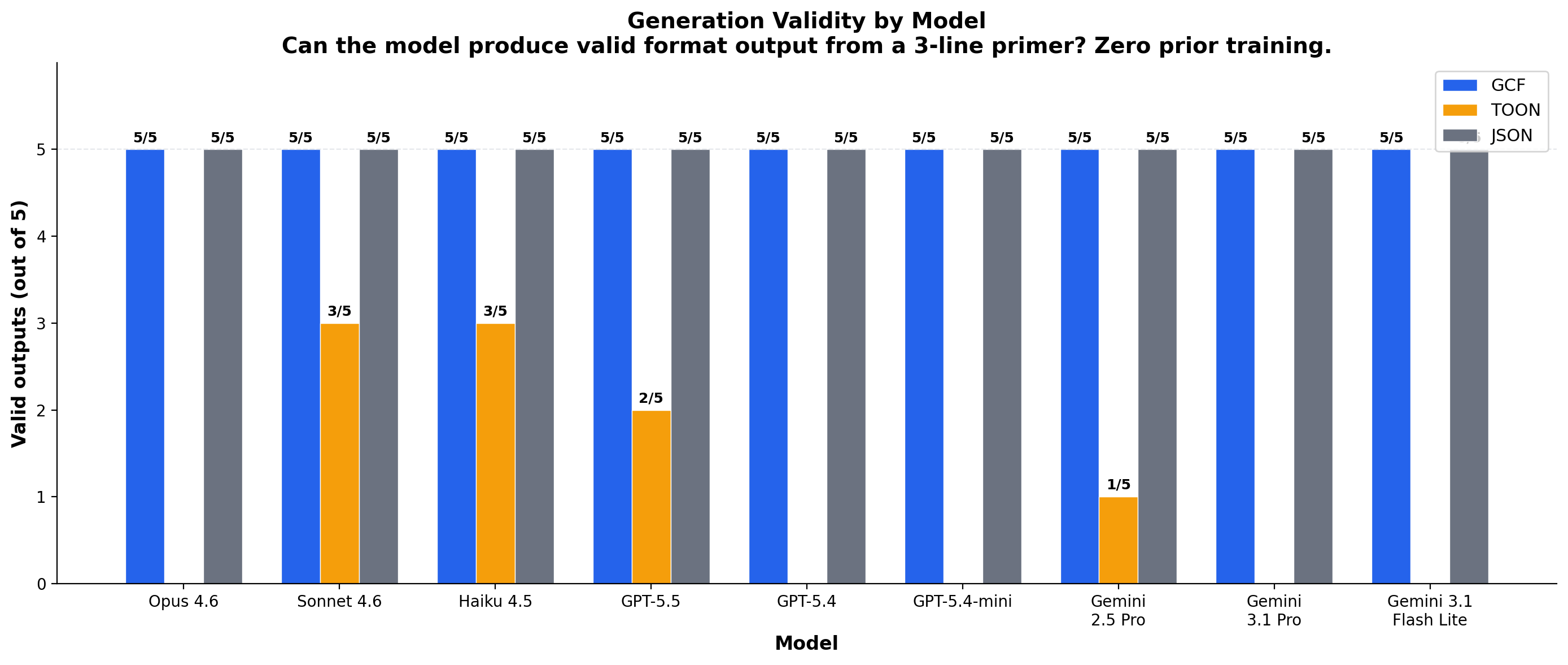
LLM generation. 28 generation runs across 9 models and 3 providers. GCF achieves 5/5 validity on every frontier model (Opus, Sonnet, GPT-5.5, Gemini 2.5 Pro, Gemini 3.1 Pro) with a 3-line primer and zero prior training. TOON's official decoder rejects LLM-generated output on 7 of 9 models. The failure is structural: TOON's flat columns encode semantic categories as integers, and models write labels ("target") instead of the expected integer (0). GCF expresses categories through section placement (## targets), aligning with how models naturally express grouped data. GCF output is 63% smaller than JSON and 33% smaller than TOON.
Two profiles. The graph profile is optimized for typed nodes and edges. The generic profile (encodeGeneric) handles arbitrary structured data (arrays of objects, nested records, mixed types). On TOON's own benchmark (expanded to 16 datasets), GCF wins 15 of 16 with 29% fewer tokens overall.
Session statefulness requires coordination. The session ID system assumes the server tracks which nodes have been transmitted to which client. Stateless deployments cannot use session compression. The non-session mode (full retransmission) remains available.
Tokenizer dependency. Token counts depend on the tokenizer. The benchmarks in this paper use o200k_base. Different tokenizers produce different token counts for the same GCF payload, though the relative savings versus JSON are consistent (within 2-3 percentage points across all 43 tested tokenizers). More importantly, GCF's structural boundaries are consistent: the pipe delimiter is always its own token on 43/43 tokenizers, while JSON's quote merges with field names on 13/43.
9. Implications for MCP and Agent Tooling
The MCP specification does not define a standard for tool response encoding beyond "the response is a JSON-RPC result." This means every MCP server independently decides how to format its output. The result is that agents receive verbose JSON from every tool, with no mechanism to request compact encoding.
We propose that MCP tool responses should support format negotiation: the client specifies a preferred encoding in the tool call, and the server returns the response in that encoding. GCF (or a format like it) should be available as a standard option alongside JSON.
The token savings are too large to ignore. A 50-92% reduction in tool response tokens (depending on data complexity and session reuse) translates directly to: lower API costs, faster time-to-first-token, more room in the context window for source code and reasoning, and fewer multi-turn loops caused by context window exhaustion.
9.1 LLM Generation: GCF as a Bidirectional Format
GCF is bidirectional: LLMs can produce it, not just consume it. 28 generation runs across 9 models, validated through real decoders (including TOON's official toon-go library).
| Model | GCF | TOON (natural) | JSON |
|---|---|---|---|
| Claude Opus 4.6 | 5/5 | 0/5 | 5/5 |
| Claude Sonnet 4.6 | 5/5 | 2-3/5 | 5/5 |
| Claude Haiku 4.5 | 5/5 | 1-3/5 | 5/5 |
| GPT-5.5 | 4-5/5 | 1-2/5 | 5/5 |
| GPT-5.4 | 5/5 | 0/5 | 5/5 |
| GPT-5.4-mini | 5/5 | 0/5 | 5/5 |
| Gemini 2.5 Pro | 5/5 | 1/5 | 5/5 |
| Gemini 3.1 Pro | 5/5 | 0/5 | 5/5 |
| Gemini 3.1 Flash Lite | 4-5/5 | 0/5 | 4-5/5 |
GCF 5/5 on every frontier model. TOON fails on 7 of 9 models.
Why TOON fails generation
TOON's flat tabular design encodes semantic categories as column values. When told "this symbol is a target," the model writes target in the distance column. TOON's decoder expects 0. The model would need to know, unprompted, that "target" maps to 0, "related" maps to 1, "extended" maps to 2. No model does this. The error is always the same: toon: cannot assign string to int.
This is a structural design flaw in flat tabular formats. Any time a column encodes a semantic category as an integer, the format is one prompt change away from producing invalid data. TOON is fundamentally fragile for LLM generation.
GCF expresses categories through section placement (## targets, ## related). The model writes the symbol in the section matching the label. No integer mapping required. The format aligns with how LLMs naturally express grouped data.
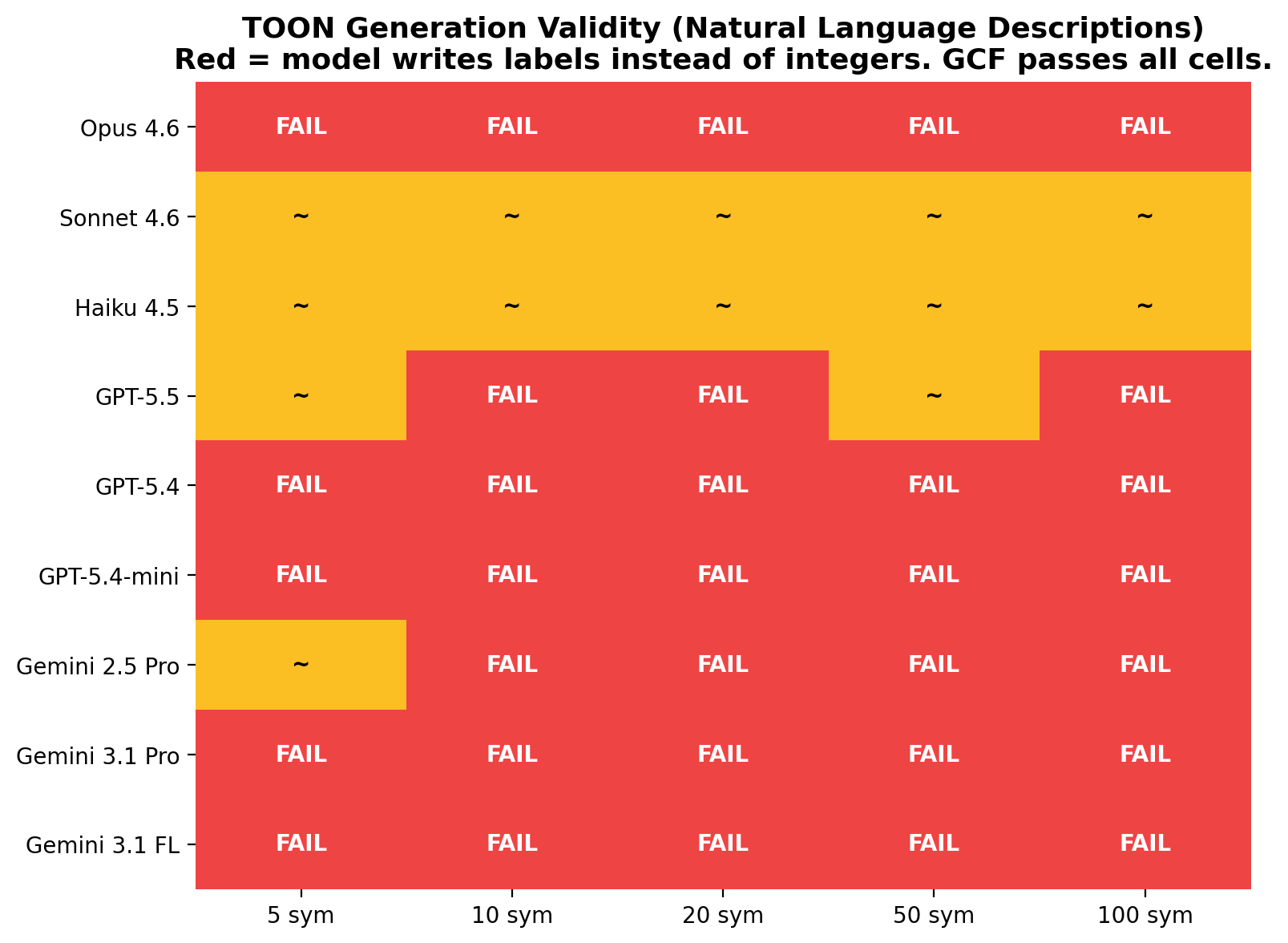
When TOON is given pre-encoded integers (hand-holding the model through the mapping), performance improves on some models but remains inconsistent. Even in the best case, GCF output is 28% smaller.
Output size comparison
| Format | 100 sym output | vs JSON |
|---|---|---|
| GCF | 5,976 B | 63% fewer |
| TOON | 8,937 B | 45% fewer |
| JSON | 16,121 B | baseline |
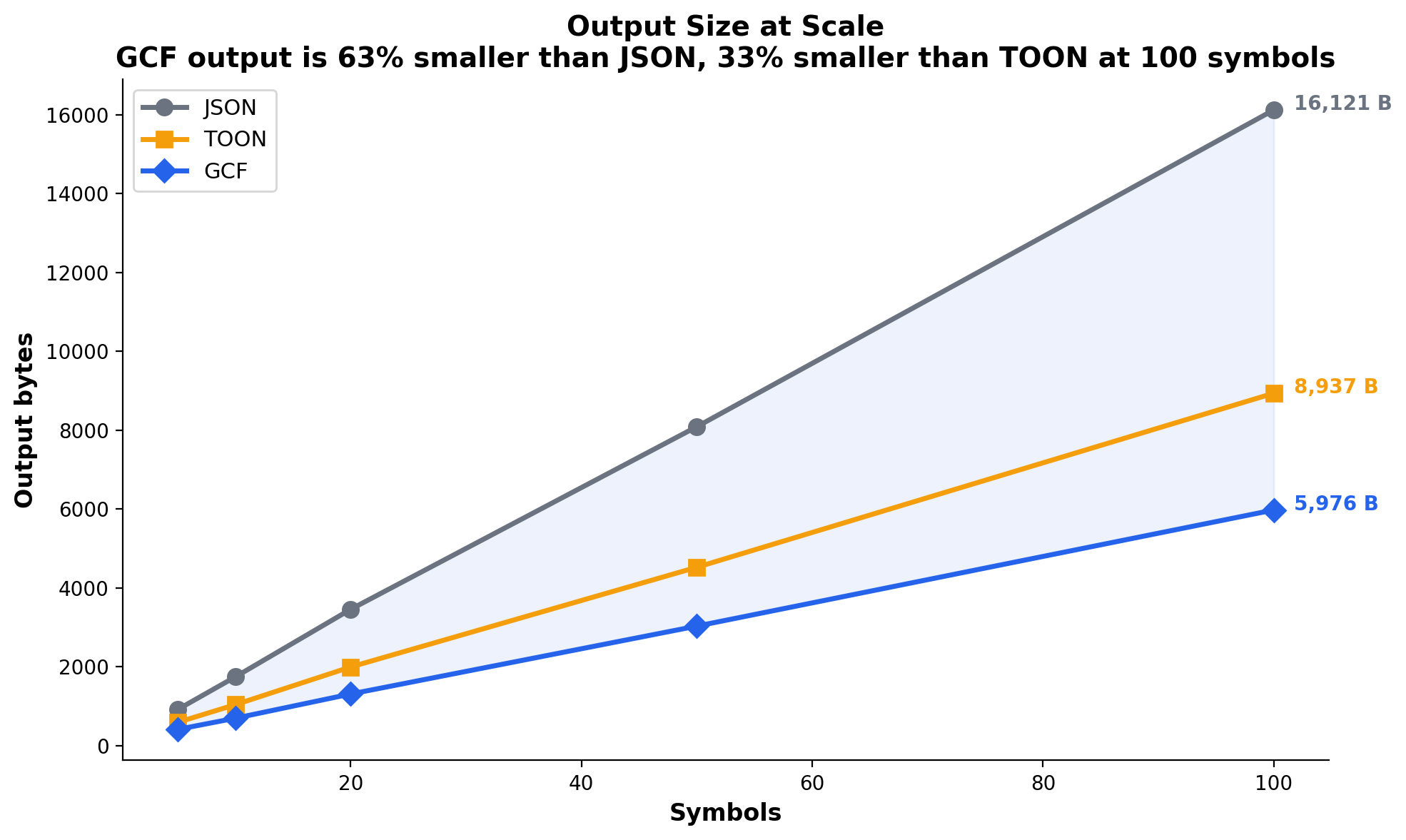
Implications. GCF generation enables: (1) agent-to-agent communication at 63% fewer tokens per handoff, (2) structured output mode as an alternative to JSON mode, and (3) system prompt encoding where context packs are encoded as GCF to maximize context window utilization.
9.2 Streaming: Progressive Context Delivery
The streaming encoding extension (Section 3.8) enables a new interaction pattern: progressive context delivery. An MCP proxy can emit GCF fragments as MCP progress notifications while the upstream server is still processing. The LLM receives partial context immediately, reducing perceived latency from seconds to milliseconds on large graph traversals.
Combined with MCP's Streamable HTTP transport (Server-Sent Events), this creates a pipeline where graph data flows from the server through the proxy to the LLM token by token, with the trailer summary providing count verification at the end.
9.3 Delta Encoding
GCF's token savings compound with delta encoding: when the agent passes a pack_root from a prior call and the pack changed, the server sends only added/removed symbols instead of the full payload. Measured: 81.2% additional token savings at 96.6% symbol overlap on re-query scenarios. Combined with GCF's baseline savings and session deduplication, the three-level stack achieves over 97% cumulative token reduction on warm sessions versus stateless JSON.
10. Conclusion
JSON fails at scale for two compounding reasons. The visible reason is overhead: 81% of JSON's tokens are repeated field names and structural characters. The invisible reason is structural ambiguity: JSON's grammar characters merge with adjacent content in BPE tokenizer vocabularies, hiding field boundaries inside single tokens. At 500 rows, the model must process approximately 8,500 overhead tokens that are also structurally ambiguous. Grammar attention collapses from 30% to 8.6%. Comprehension drops to 53.4%.
GCF eliminates both problems. Header factoring eliminates the overhead (field names declared once, 97.7% signal at 500 rows vs JSON's 19%). Delimiter selection from the empirically verified low-merge character set eliminates the ambiguity (pipe: 0.47% merge rate, 24 mergeable words vs JSON's 1,939). A controlled experiment proves this is causal: a model trained with merge barriers on delimiter characters (preventing them from fusing with adjacent content) achieves 3x better structured data comprehension and 3-5x better code comprehension, with zero cost to natural language. The model develops 4.6x more attention heads dedicated to parsing structure.
GCF is bidirectional. 2,500+ LLM evaluations across 11 models and 4 providers prove it. Comprehension: 100% on every frontier model on standard workloads; 91.2% on structurally complex code graphs where JSON drops to 53.4% and TOON to 68.2%. Generation: 5/5 validity on every frontier model where TOON fails on 7 of 9 models. Output: 63% fewer tokens than JSON, 33% fewer than TOON. Session deduplication (84.3% cumulative savings over a 5-call session), delta encoding (81.2% on re-queries), and streaming encode (zero-buffering with trailer summary) compound savings across multi-turn interactions. No competing format offers these features.
The format is text-based, LLM-optimized, and implementable in any language. Implementations exist in six languages (Go, TypeScript, Python, Rust, Swift, Kotlin) with zero or minimal runtime dependencies. A drop-in MCP proxy enables adoption with zero code changes and adds streaming progress notifications for immediate partial context delivery.
GCF is a wire format. Wire formats are not optimized for human readability. HTTP headers are not readable. Protobuf is not readable. Nobody cares; they use a viewer. GCF is the wire format; JSON is the viewer format. The agent reads GCF (cheap, accurate), does its work, then calls decode() at the end if a human needs to see the result.
The format that looks clean to humans (JSON) is the one that breaks for agents at scale: its overhead wastes tokens and its grammar hides structural boundaries. The format optimized for agentic comprehension (GCF) achieves 100% accuracy on every frontier model for standard workloads and 91.2% on structurally complex data, at the lowest token cost, with grammar that never merges with field names on any tested tokenizer. TOON's tab delimiter has 1,238 mergeable words across 43 tokenizer vocabularies, 52x the pipe's 24. Its comprehension never reaches 100%, and its generation fails on 7 of 9 models. This is not a tradeoff. It is a design choice validated by 2,500+ evaluations, a 43-tokenizer vocabulary analysis, and a controlled model training experiment.
Reference Implementation
- Specification: SPEC.md (v3.1 Stable, RFC 2119 keywords, conformance checklists, streaming extension, error taxonomy). Published at gcformat.com.
- Go library:
github.com/blackwell-systems/gcf-go(v0.6.1) - TypeScript library:
@blackwell-systems/gcfon npm (v0.6.1) - Python library:
gcf-pythonon PyPI (v0.5.1) - Rust library:
gcfon crates.io (v0.5.1) - Swift library:
gcf-swiftvia SPM (v0.5.1) - Kotlin library:
gcf-kotlinvia JitPack (v0.5.1) - MCP proxy:
github.com/blackwell-systems/gcf-proxy: streaming progress notifications, drop-in wrapper, zero code changes - Comprehension eval:
github.com/blackwell-systems/gcf-go/eval(generic profile: 500 orders, 27 runs, 11 models; graph profile: 500 symbols, 24 runs, 10 models; 13 questions, 3 formats) - Tokenizer analysis:
github.com/blackwell-systems/gcf/eval(13 scripts, 43 tokenizers, 20 providers). See "Merge Barriers in BPE Tokenization" DOI: 10.5281/zenodo.20925910. - Generation eval:
github.com/blackwell-systems/gcf-go/eval(5-100 symbols, GCF vs TOON vs JSON, 9 models, validated through real decoders) - Eval results:
github.com/blackwell-systems/gcf/eval/results(all raw logs, failure taxonomy, artifacts) - TOON benchmark fork:
github.com/blackwell-systems/toon(branch: gcf-comparison, their datasets, their tokenizer) - Conformance test suite:
github.com/blackwell-systems/gcf/tests/conformance(157 v3 fixtures across both profiles, streaming, and normative errors) - Interactive playground: gcformat.com/playground (three-way JSON vs TOON vs GCF comparison using real @toon-format/toon library)
- Production deployment: knowing (28 MCP tools), agent-lsp (66 MCP tools)
Appendix A: Full Example
JSON (965 tokens):
{
  "tool": "context_for_task",
  "tokens_used": 1847,
  "token_budget": 5000,
  "symbols": [
    {
      "qualified_name": "github.com/blackwell-systems/knowing/internal/mcp.requireHash",
      "kind": "function",
      "score": 0.78,
      "signature": "func requireHash(args map[string]any, key string) (types.Hash, error)",
      "provenance": "lsp_resolved",
      "distance": 0,
      "components": { "blast_radius": 0.40, "confidence": 0.25, "recency": 0.06, "distance": 0.15 }
    },
    {
      "qualified_name": "github.com/blackwell-systems/knowing/internal/mcp.NewServer",
      "kind": "function",
      "score": 0.54,
      "provenance": "lsp_resolved",
      "distance": 1
    }
  ],
  "edges": [
    {
      "source": "github.com/blackwell-systems/knowing/internal/mcp.NewServer",
      "target": "github.com/blackwell-systems/knowing/internal/mcp.requireHash",
      "edge_type": "calls"
    }
  ]
}
GCF (233 tokens):
GCF profile=graph tool=context_for_task budget=5000 tokens=1847 symbols=2 edges=1
## targets
@0 fn github.com/blackwell-systems/knowing/internal/mcp.requireHash 0.78 lsp_resolved
## related
@4 fn github.com/blackwell-systems/knowing/internal/mcp.NewServer 0.54 lsp_resolved
## edges [1]
@0<@4 calls
Same semantic content. 75.9% fewer tokens.
Appendix B: Streaming Example
Buffered mode (full payload known upfront):
GCF profile=graph tool=context_for_task budget=5000 symbols=3 edges=2
## targets
@0 fn pkg.Auth 0.95 lsp_resolved
@1 fn pkg.Handler 0.88 lsp_resolved
## related
@2 type pkg.Config 0.72 ast_inferred
## edges [2]
@0<@1 calls
@2<@0 references
Streaming mode (data arriving incrementally):
GCF profile=graph tool=context_for_task budget=5000
## targets
@0 fn pkg.Auth 0.95 lsp_resolved
@1 fn pkg.Handler 0.88 lsp_resolved
## related
@2 type pkg.Config 0.72 ast_inferred
## edges [?]
@0<@1 calls
@2<@0 references
##! summary symbols=3 edges=2 sections=targets:2,related:1,edges:2
Both produce identical Payload structures when decoded. The streaming mode enables zero-buffering encode with O(1) memory per row.