GCF on Small Models
GCF has three advantages over JSON and TOON: it is lossless, it is compact, and models read it more accurately. The first two hold on every model. GCF round-trips where TOON silently corrupts, and it is smaller than JSON, no matter who is reading. Those are not small-model facts; they are true on Opus and on a 1B local model alike.
The comprehension advantage is the one whose size depends on the model, and this page is about that axis specifically. On frontier models, GCF, TOON, and JSON all read equally cleanly, so on reading accuracy alone a frontier-only pipeline could use any of them. That equivalence disappears as the model shrinks: TOON and JSON degrade first and fastest, and GCF holds. If any part of your traffic goes to a Flash, a mini, a 70B, or a local model (for cost, latency, or privacy), the format you send is the difference between the model reading the data correctly and the model getting it wrong.
(Losslessness and compactness are covered in vs-TOON and tokenizer analysis; they are not re-argued here.)
This page pulls together the small-model evidence that lives across the benchmarks, vs-TOON, delta, and tokenizer analysis pages. All numbers are from the reproducible eval suites (commands at the bottom).
The pattern in one line
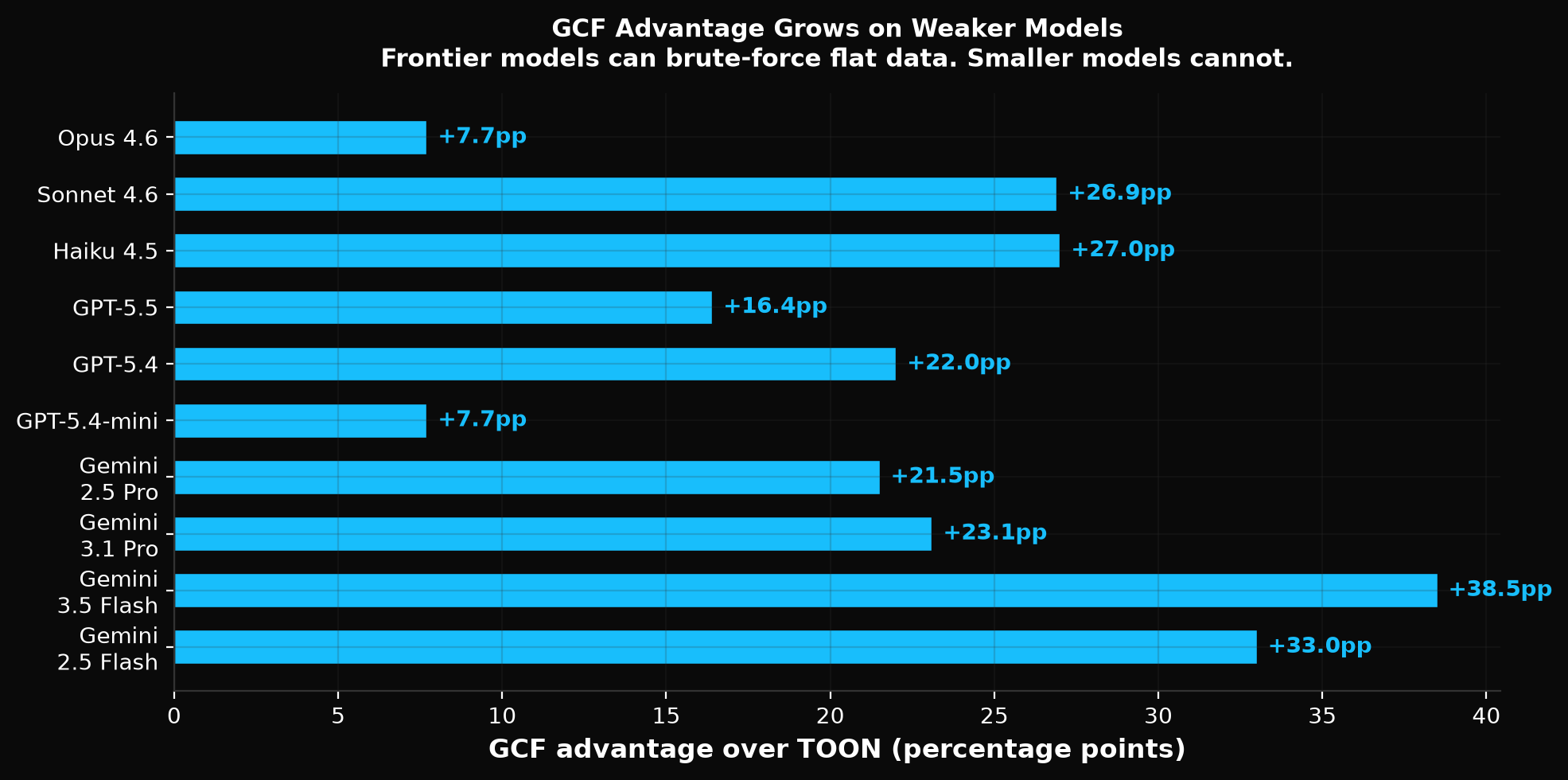
Every format reads cleanly on frontier models. As the model gets smaller, TOON and JSON degrade first and fastest; GCF holds. The comprehension gap appears only at the small end (losslessness and compactness are constant everywhere).
The same effect seen as a gradient: GCF's advantage over the alternatives grows as the model gets weaker.
1. Reading the data (comprehension)
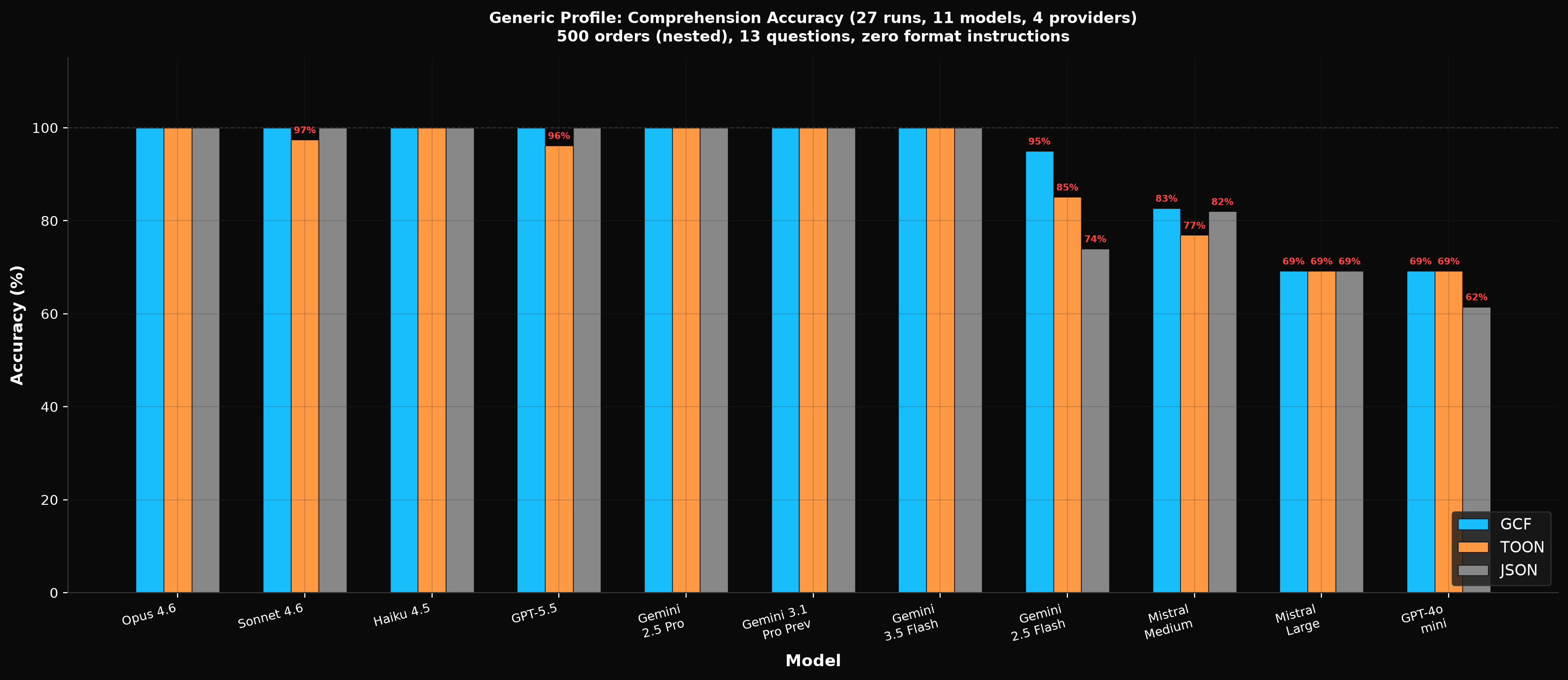
Generic profile (arrays of records, the common tool-response shape). 500-order nested data, 27 runs, 11 models. Every frontier model hits 100% on all three formats, so the averages are identical there. The models separate at the bottom of the table:
| Model | GCF | TOON | JSON |
|---|---|---|---|
| all frontier (7 models) | 100% | ~100% | ~100% |
| Gemini 2.5 Flash | 95.0% | 85.1% | 74.0% |
| Mistral Medium 3.5 | 82.7% | 76.9% | 82.0% |
On Gemini 2.5 Flash, switching from JSON to GCF is a 21-point accuracy swing, and GCF beats TOON by ~10 points. On a frontier model that same switch is worth nothing.
This is not two cherry-picked models. The same generic task was run across 19 models from 9 providers. Every frontier model ties at 100%; on the non-frontier tail, GCF beats or ties JSON on 10 of 11 open and budget models. The open-weight tail (Llama, Mistral, DeepSeek, Nova) is exactly the local-and-cheap deployment target:
| Model | GCF | JSON |
|---|---|---|
| LLaMA 3.3 70B | 84.6% | 61.5% |
| LLaMA 4 Maverick | 76.9% | 61.5% |
| DeepSeek V3 | 73.1% | 71.2% |
| GPT-4o mini | 69.2% | 61.5% |
| LLaMA 3.1 8B | 65.4% | 58.3% |
| Amazon Nova Micro | 53.8% | 41.7% |
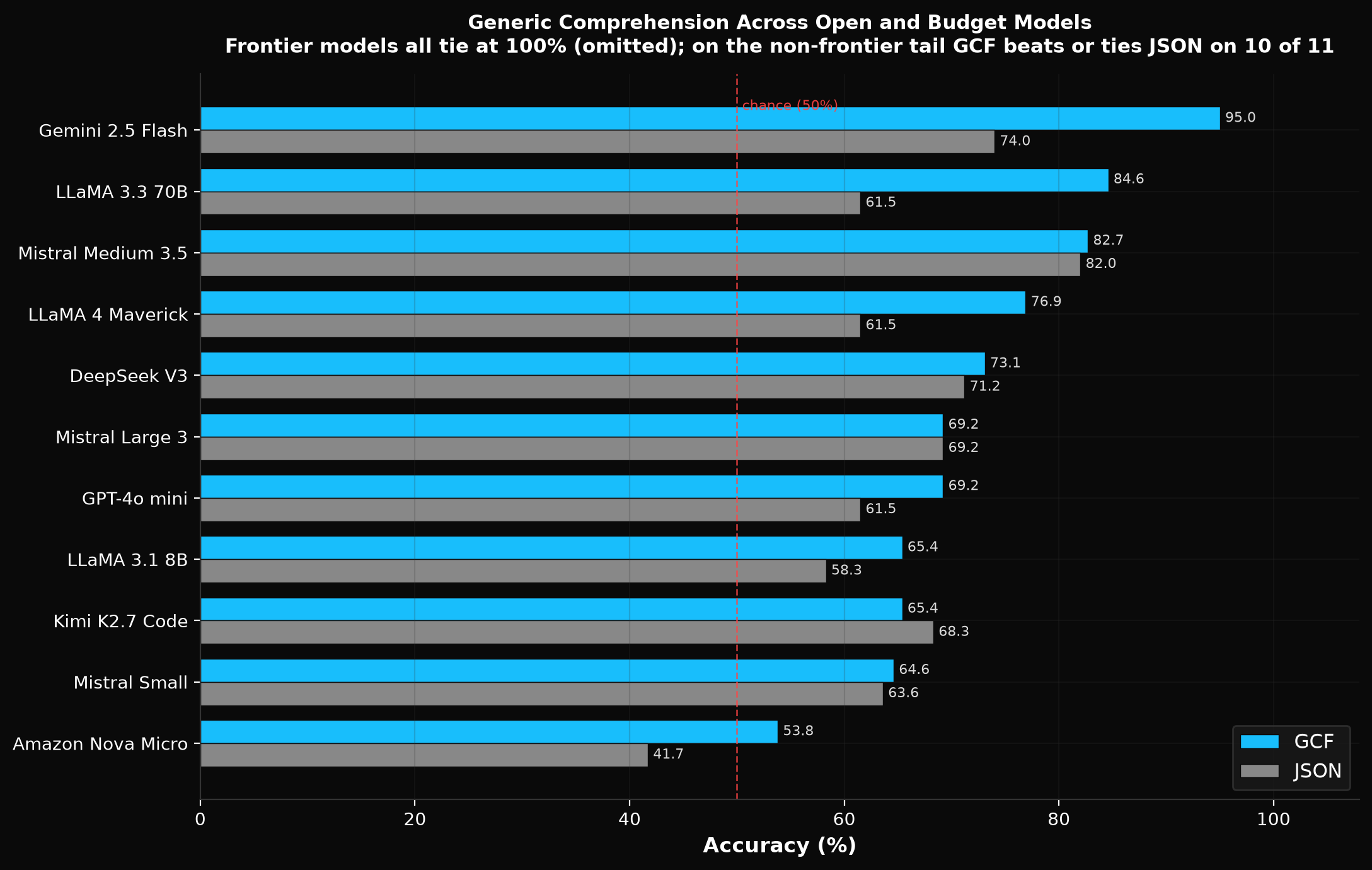
The one model where JSON edges GCF is Kimi K2.7 Code (68.3% vs 65.4%), which suits the flatten variant better. TOON was tested on a subset and was consistently the weakest of the three. Below this tail, capacity runs out for every format (IBM Granite 4.0 Micro and Qwen 3.6 35B score 31% and 25% on GCF, too low to separate formats): GCF is a comprehension aid, not a substitute for model capability.
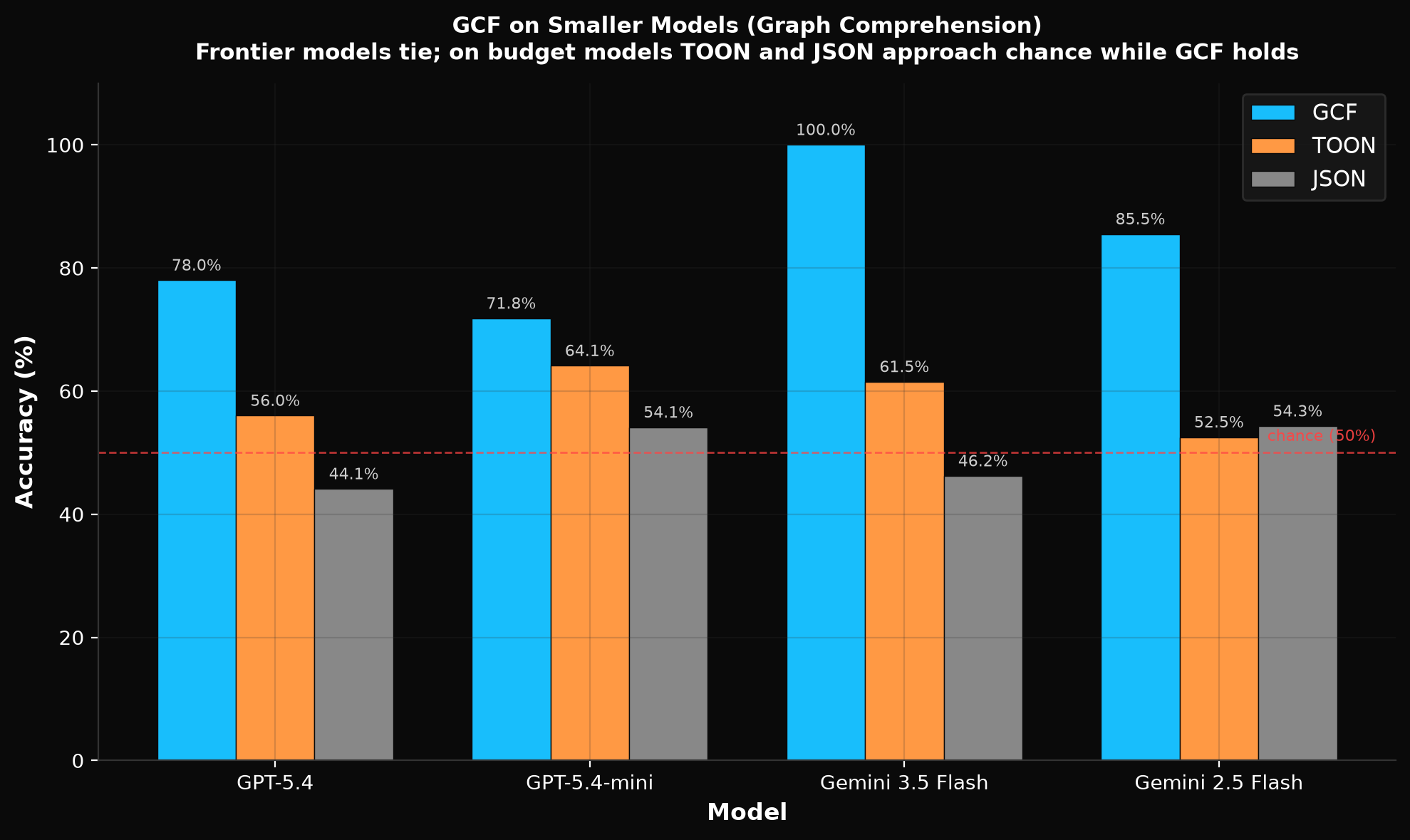
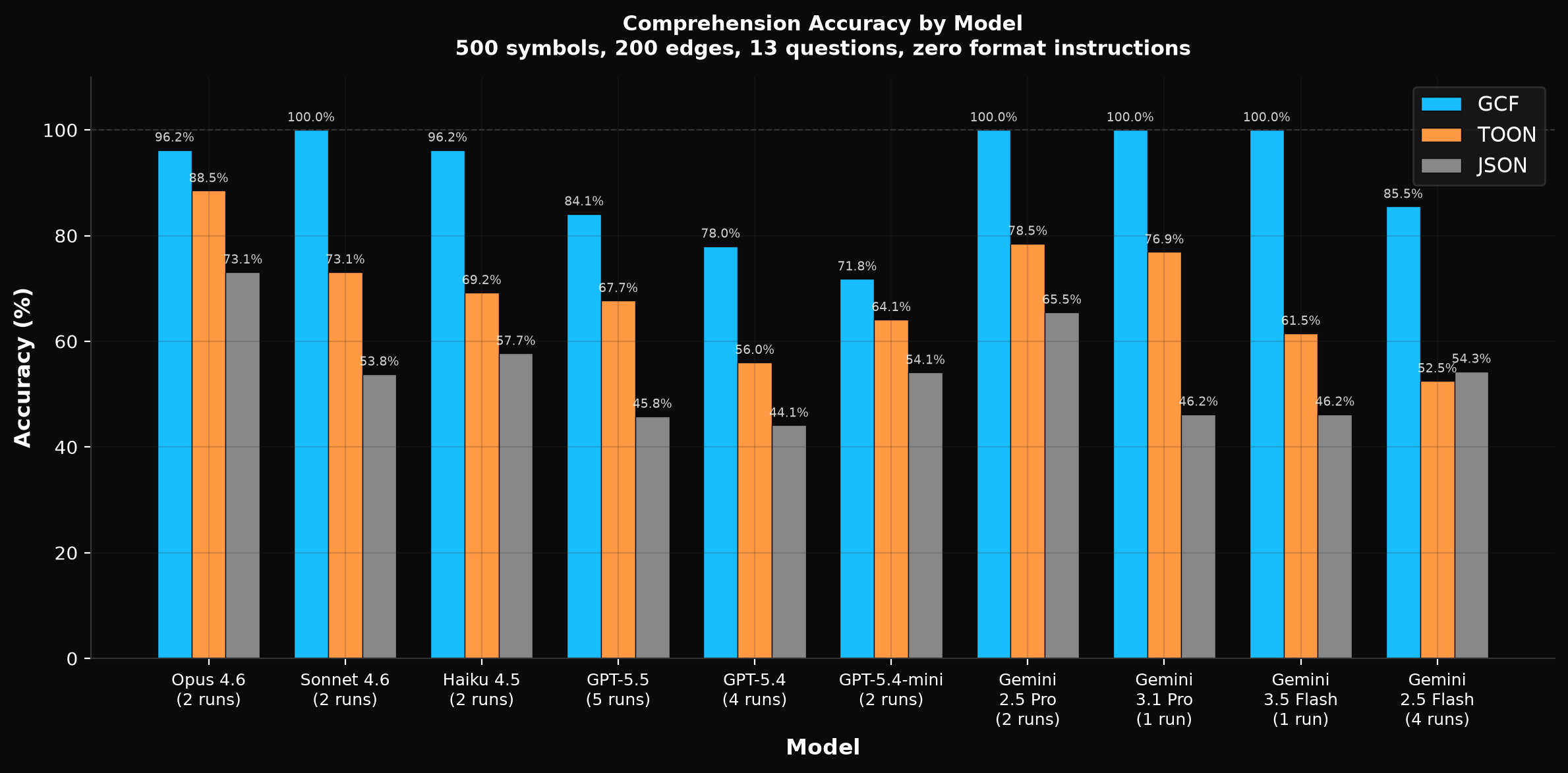
Graph profile (symbols and edges, under structural stress). 500-symbol code graphs, 25 runs, 10 models. Here GCF leads on every model, and the lead widens as the model shrinks:
| Model | GCF | TOON | JSON |
|---|---|---|---|
| Gemini 3.5 Flash | 100% | 61.5% | 46.2% |
| Gemini 2.5 Flash | 85.5% | 52.5% | 54.3% |
| GPT-5.4-mini | 71.8% | 64.1% | 54.1% |
Canonical averages (mean of per-model): GCF 91.2%, TOON 68.8%, JSON 54.1%. On the small models the TOON and JSON numbers fall into the 40s and 50s (coin-flip territory on structured retrieval) while GCF stays in the 70s to 100.
2. Writing the data (generation)
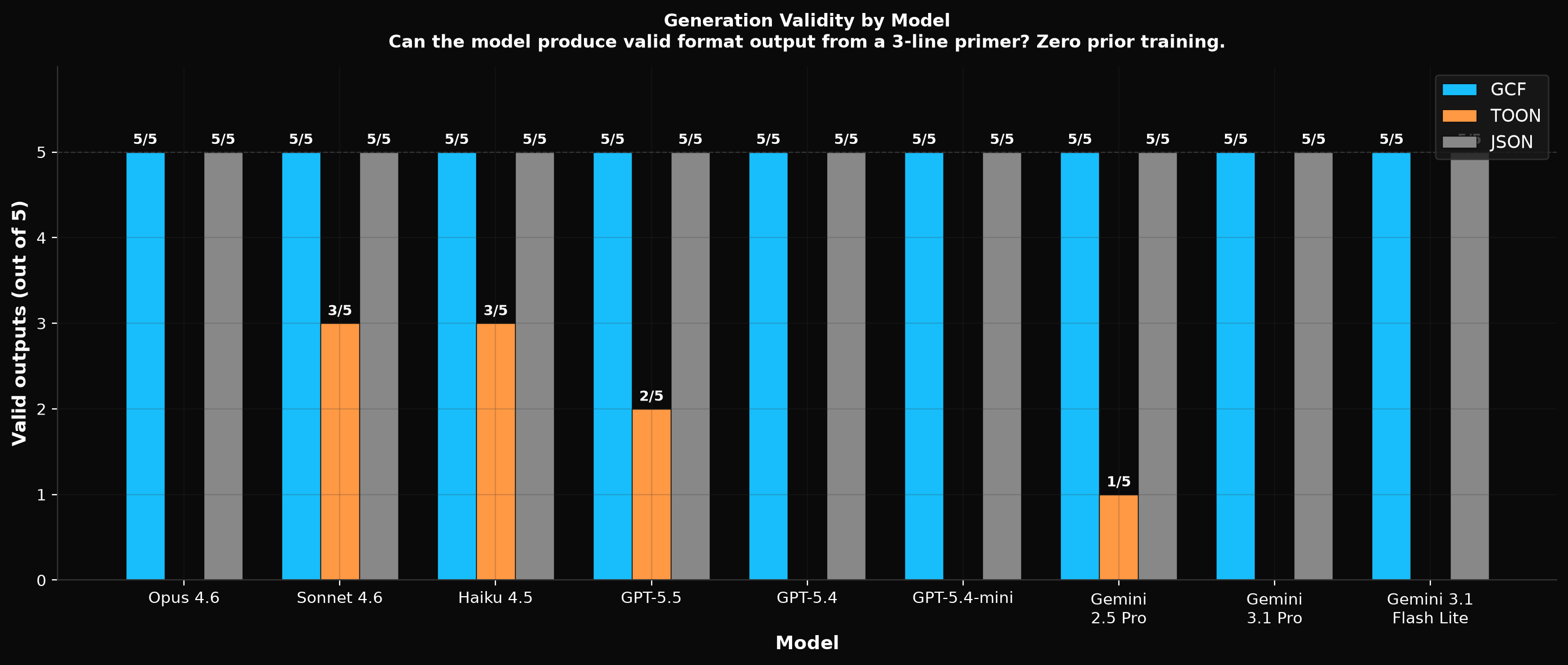
Comprehension is only half the loop. If your agent is expected to produce the format, small models are where TOON breaks down entirely. 28 runs, 11 models:
| Model | GCF | TOON | JSON |
|---|---|---|---|
| GPT-5.4-mini | 5/5 | 0/5 | 5/5 |
| Gemini 3.1 Flash Lite | 4-5/5 | 0/5 | 4-5/5 |
| Gemini 3.5 Flash | 3/5 | 1/5 | 3/5 |
| Gemini 2.5 Flash | 2-4/5 | 0-4/5 | 0-3/5 |
TOON's official decoder rejects LLM-generated output on 7 of 9 models. Its flat tabular design encodes semantic categories as integers, which forces a mapping that smaller models do not perform unprompted. GCF is the only compact format every frontier model produces at 5/5, and it remains the most producible format as the model shrinks. On the mid-tier Flash models where GCF itself dips below 5/5, JSON and TOON drop further (GCF 3.0 vs JSON 1.7 vs TOON 1.3 on Gemini 2.5 Flash).
3. Knobs that help small models (all optional, all measured)
Sections 1 and 2 are about the format as it ships. On top of that, GCF exposes a handful of optional, producer-side knobs whose entire purpose is to help small, weak, and local models. They share three properties: none changes the wire for a decoder (a plain reader ignores them), none costs a frontier model anything (it is already at ceiling), and each was measured in its own study before shipping. If you route to cheap models, these are the dials you turn.
Re-anchor: rescue long sessions
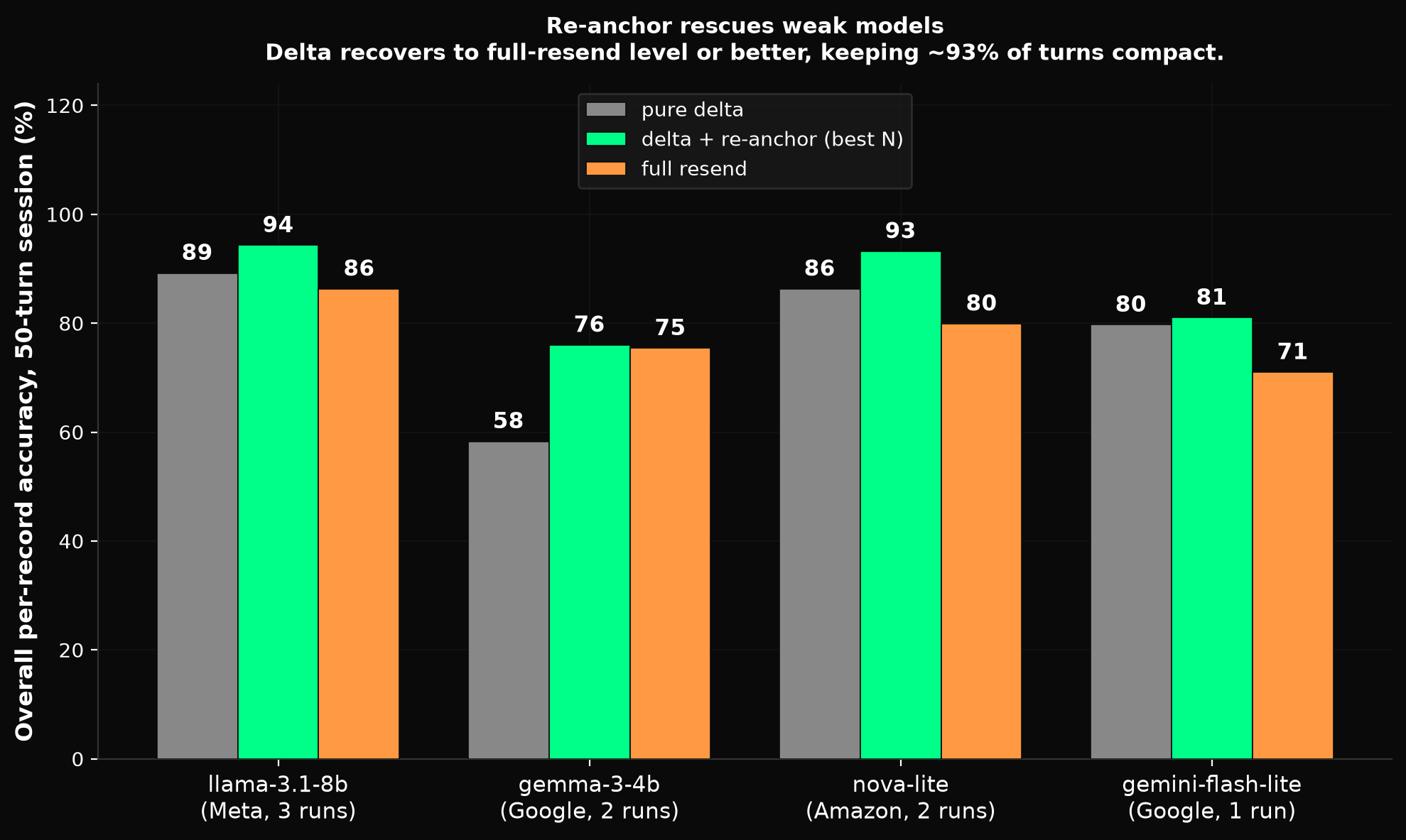
Multi-turn delta encoding re-sends only changed rows, so the base recedes as a session deepens and a weaker model has more to reconstruct. A 50-turn stress test (50-row table, 5% churn per turn) held per-record retrieval essentially perfect across weak-to-frontier models (1,777 of 1,777 correct). The one drift case is a small model at the deep end: llama-3.3-70b starts losing state around turns 41 to 50.
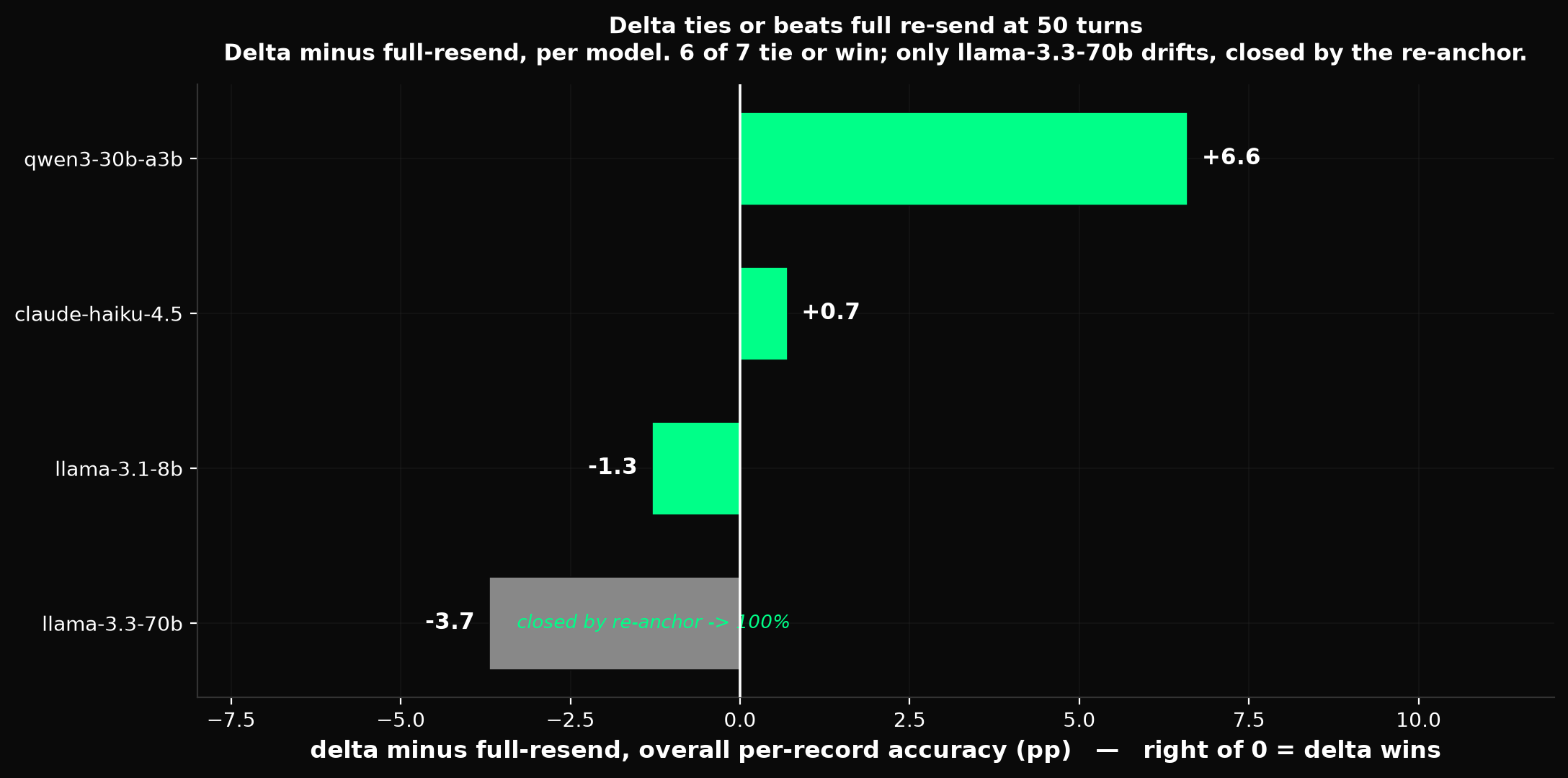
The knob is a producer-side periodic re-anchor: re-send a full payload every N turns (default 15). It costs nothing on the wire and does two things. It closes that one drift case back to 100%, and, more generally, it rescues weak models. On the weakest open models tested (Meta llama-3.1-8b, Google gemma-3-4b, Amazon nova-lite, Google gemini-flash-lite), pure delta over a 50-turn session lifts back to full-resend accuracy or better once re-anchor is on, while keeping roughly 93% of turns compact. gemma-3-4b is the clearest case: 58% pure delta up to 76%, matching full resend.
Labeled counts: rescue counting
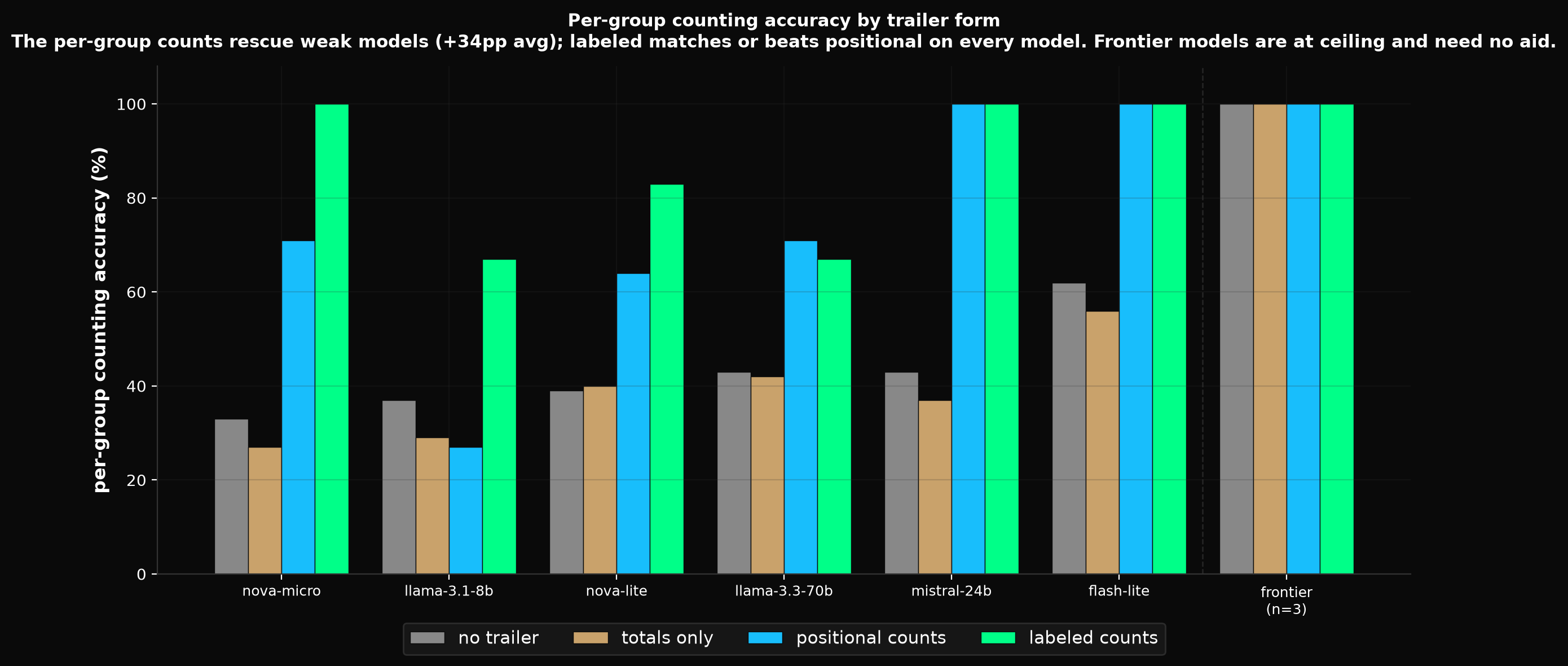
Streaming trailers carry per-group counts in a positional form (counts=2,2,3) or an optional labeled form (counts=targets:2,related:2,edges:3, spec v3.4). The labeled form is decoder-ignored and roughly free for a frontier model, but smaller models resolve a labeled per-group count far more reliably. A dedicated four-arm study (none / totals / positional / labeled, three graph sizes, per-group counting with programmatic ground truth) measured it: labeled and positional counts add about +34 points on weak and mid models on average, growing from +11pp at 15 symbols to +56pp at 500 as tallying by hand gets harder, and the labeled form adds a further ~+14pp over positional on average, rising to +29 to +40pp on the weakest models (nova-micro, llama-3.1-8b). Across six budget and open models (Amazon nova-micro/nova-lite, Meta llama-3.1-8b/llama-3.3-70b, Mistral 24B, Gemini Flash Lite), labeled counts match or beat every other trailer form; frontier models are already at ceiling and gain nothing. Positional stays the default; labeled is the knob you turn on for weak consumers.
Flatten: turn it off for open models
GCF flattens nested objects to path columns (user>login) by default, because it saves tokens and every frontier model reads the flat form at 100%. But the flatten experiment (19 models) found that open-weight models regress 8 to 23% on the flattened form versus the nested form, while proprietary frontier models show zero regression. Flatten is therefore shipped as opt-out: leave it on for frontier traffic, turn it off when you route nested data to open-weight or local models. (The > path separator was chosen the same way: it beats ; deterministically on Gemini 2.5 Flash, 100% vs 92.3%.)
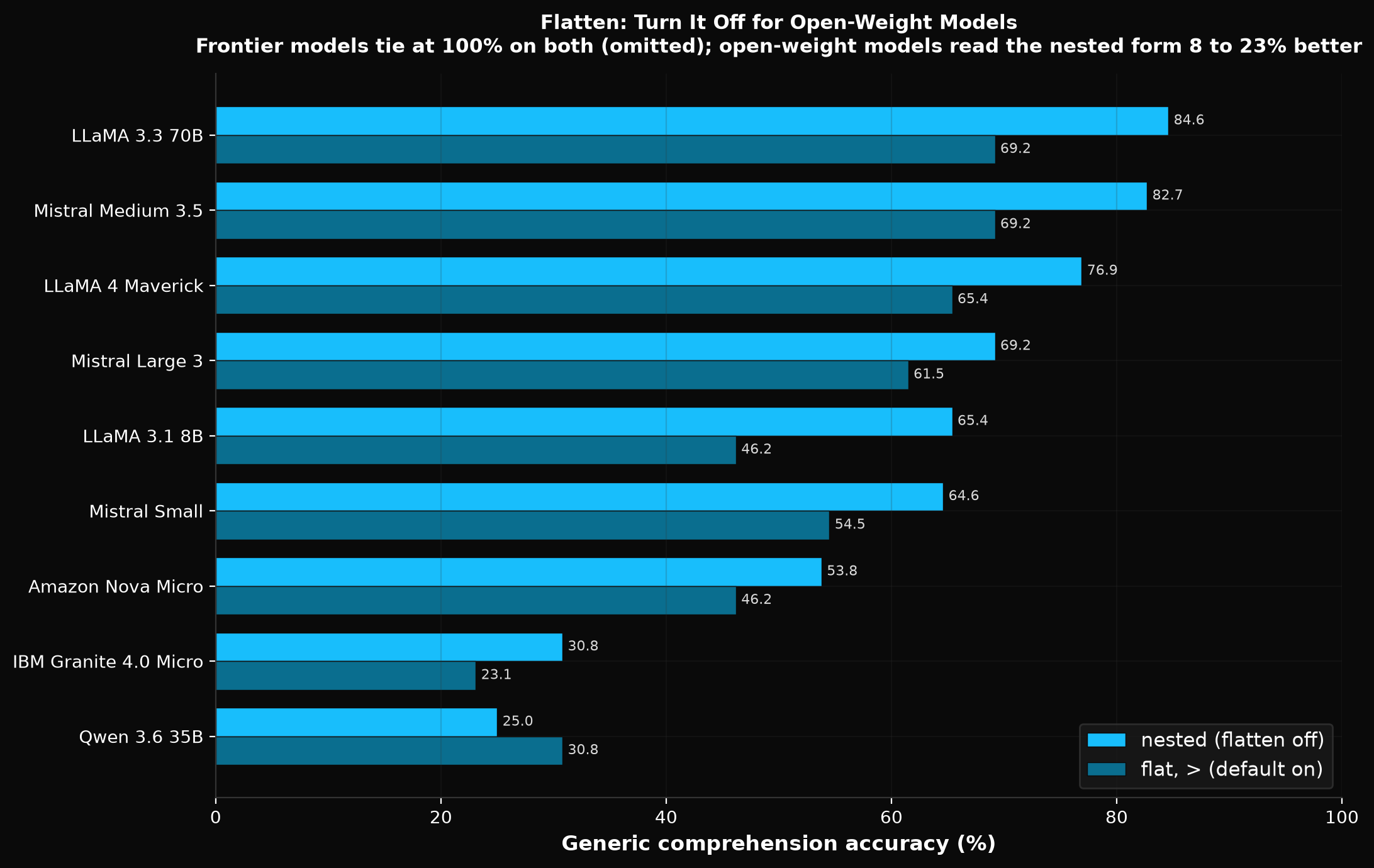
The one exception is Qwen 3.6 35B, where the flatter layout helps slightly (like Kimi in section 1); everywhere else on the open-weight tail, nested reads clearly better.
Why the gap lives at the small end
Frontier models have enough capacity to overcome noisy tokenization; small models do not, so the encoding's tokenizer behavior shows up directly in accuracy.
TOON's tab delimiter merges with adjacent content far more than the alternatives: across 43 tokenizers and 29,025 checks, GCF's pipe merges 0.47% of the time, JSON's quote 8.17%, and TOON's tab 32.91%, the worst of any common separator. GPT-4's vocabulary alone has 1,173 tab-plus-letter entries versus 22 for pipe. Those merges are boundary noise a large model can look past and a small model cannot.
This is grounded in original tokenizer and attention research (under review), which shows through controlled training that BPE merge decisions permanently constrain which attention heads develop. See the tokenizer analysis and the companion papers linked from the whitepaper. The short version: the delimiter you pick shapes what small models can parse, and TOON picked the delimiter with the largest adversarial surface.
Bottom line
If your traffic is 100% frontier, GCF is still lossless and still smaller on the wire on every call; only its comprehension margin is a safety net you may not need there. The moment any traffic routes to a cheaper or local model (the standard cost optimization for agent workloads), comprehension joins the other two, and the small-model numbers are the ones that decide the outcome:
- Comprehension holds where TOON and JSON fall to coin-flip.
- Generation stays valid where TOON's decoder rejects the output.
- And three optional producer-side knobs, each measured, each free on the frontier and aimed squarely at cheap models: re-anchor rescues long sessions, labeled counts add up to +34 points on counting, and turning flatten off recovers 8 to 23% on open-weight models.
Reproduce
# Generic profile comprehension (frontier + small models)
GOWORK=off EVAL_FORMATS=gcf,json,toon EVAL_BACKEND=cli EVAL_MODEL=haiku EVAL_NUM_ORDERS=500 go test -run TestGenericComprehension -v -timeout 0

# Graph profile comprehension
GOWORK=off go test -run TestComprehension -v -timeout 0

# Generation (can the model write it)
GOWORK=off go test -run "TestGeneration$|TestGenerationTOON|TestGenerationJSON" -v -timeout 0
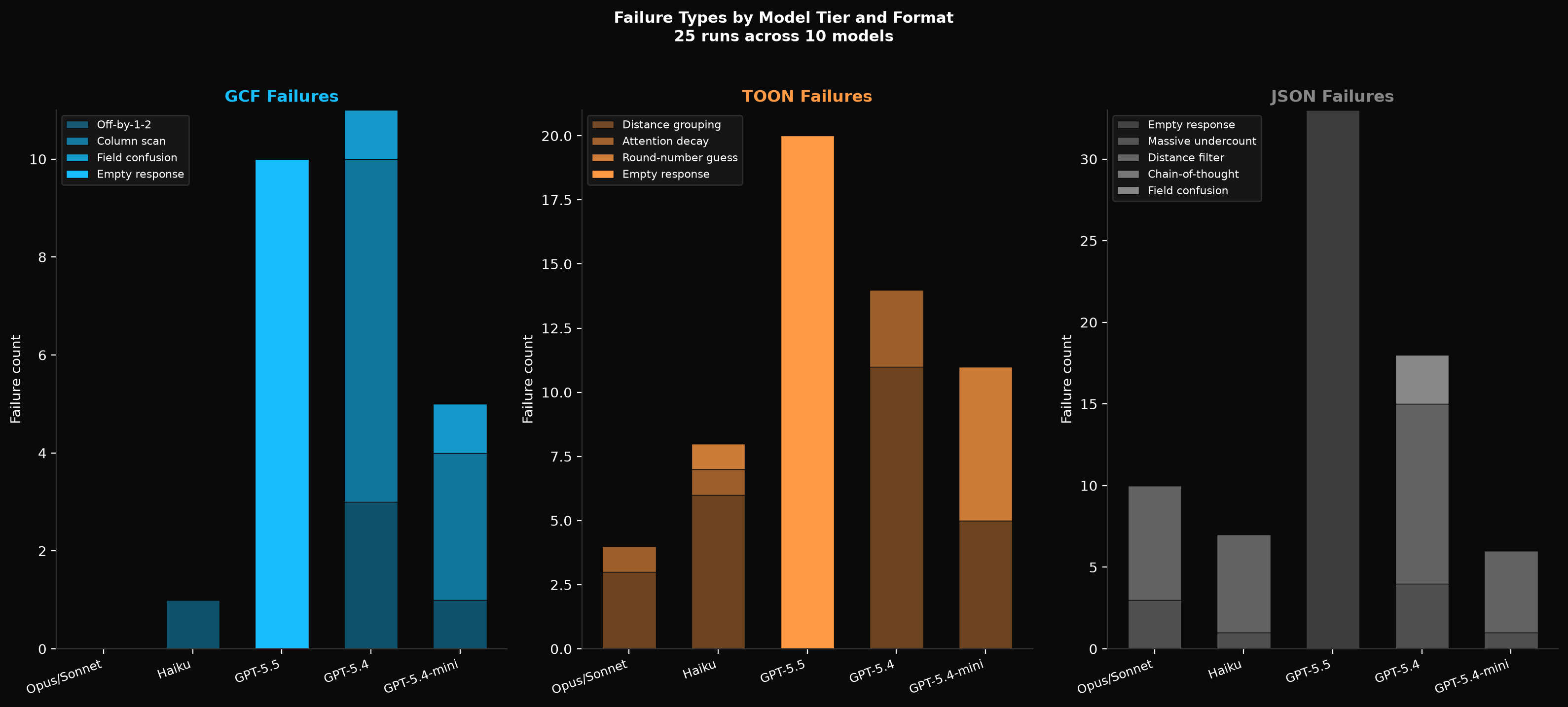
Per-run data, error taxonomy, and failure-by-tier charts are in the full eval results.